
Key Highlights
- Russian officials have stated that crypto mining is helping boost the ruble, highlighting how digital currencies are starting to influence Russia’s everyday financial system.
- Russia’s regulated mining sector and hidden flows show cryptocurrencies are becoming an important factor in national currency stability.
- Global mining trends and local regulations reveal that Bitcoin and other digital assets now impact both Russia’s economy and regional markets.
Russian officials say cryptocurrency mining may be helping strengthen the ruble, pointing to potential changes in the country’s financial landscape. Central Bank Governor Elvira Nabiullina noted Bitcoin mining as a possible factor in the currency’s recent gains.
Speaking to RBC at a press conference, she noted that measuring the exact impact remains challenging due to the sector’s significant gray-area activity. Deputy Chief of Staff Maxim Oreshkin further explained that underestimating mining-related financial flows has previously led to inaccurate ruble exchange rate forecasts.
He emphasized that cryptocurrency mining has evolved into a new export item, influencing Russia’s foreign exchange market. “The Bank of Russia is assessing this market, and these figures should be factored into the balance of payments,” Oreshkin said. He added that the sector’s low visibility stems from its operations outside standard channels.
Mining legalization and regulation
Russia made it legal to mine cryptocurrency a year ago, but the structure of the industry keeps on changing. Starting November 1, 2024, private entrepreneurs and legal entities are eligible to mine cryptocurrencies as part of a special register with the Federal Tax Service (FTS).
People may mine on their own, although power consumption must not exceed 6,000 kWh. Furthermore, it has been mandatory for those running mining infrastructure, such as data centers, to register on the FTS and declare income.
According to the Industrial Mining Association (IMA), Russia ranks second globally in Bitcoin mining after the U.S., controlling over 16% of the global hashrate during summer months. Nabiullina emphasized that mining did not suddenly surge in 2025. “There’s probably been some increase. Nevertheless, mining is indeed one of the additional factors contributing to the ruble’s strong exchange rate,” she said.
Officials say it’s urgent to tidy up Russia’s crypto sector. First Deputy Chairman of the Bank of Russia, Vladimir Chistyukhin, urged stricter rules, and authorities are working with finance agencies to make sure future transactions go through licensed platforms.
Global mining trends
Globally, Bitcoin mining is regaining momentum. China, which banned mining in 2021, has seen small and large miners return, especially in power-rich provinces like Xinjiang. Wang, a private miner, explained, “A lot of energy cannot be transmitted out of Xinjiang, so you consume it in the form of crypto mining. New mining projects are under construction.” This revival coincided with a Bitcoin price surge in October, boosting network activity and profitability.
Presently, as per worldpopulation data, Bitcoin mining in the USA dominates with 37.84% of average monthly hashrate. China has the second highest with 21.11%, followed by Kazakhstan with 13.22%, Canada with 6.48%, and Russia with 4.66%.
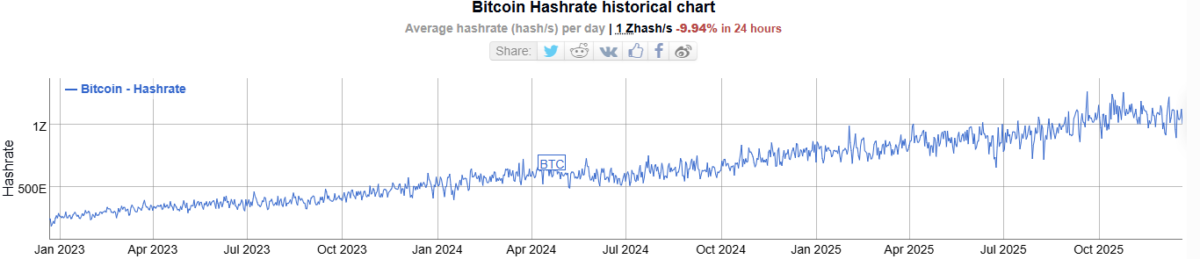
Data on Bitinfocharts reveals that Bitcoin hashrate has gradually risen from 200 exahash/s in early 2023 to over 1 zettahash/s in late 2025. This is despite the fluctuating percentage changes of -10.56% recorded in the last day.

Regional implications
Regional nations also take measures concerning risks involving mining. In Tajikistan, electricity theft in mines has recently been made an offense, with fines-ranging between 1,650 USD to 8,250 USD or an eight-year sentence involving major offenses. Damages amounting to approximately 4.26 million USD were reported involving about 4,000 persons by August 2025.
The regulations regarding cryptos in Russia, as well as the rubble’s reaction to mining, are indicative of the integration of cryptos with the financial system.
Also Read: CBI Uncovers Crypto-Linked Fraud at India’s Geneva Mission