

Key Highlights
- Big Bitcoin holders are selling while small investors keep buying, showing a clear shift in market behavior since October 2025.
- Mid-sized wallets are mixed: smaller ones are accumulating, bigger ones are selling, which may limit Bitcoin’s rally potential.
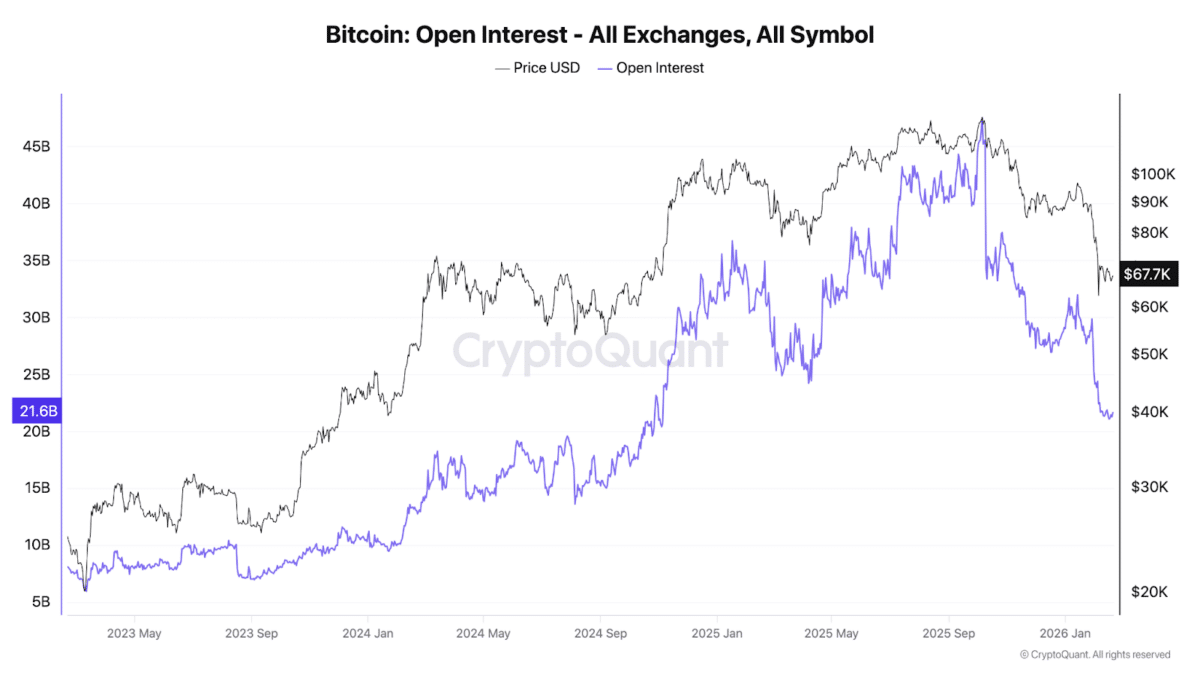
- Bitcoin’s futures open interest fell sharply from $45B to $21.6B, signaling forced selling and weaker market momentum.
Bitcoin (BTC) is showing a shift in market behavior as big holders sell while small investors keep buying. Bitcoin is currently trading at around $67,786 with $35.2 billion worth of trading volume in the last 24 hours. The total crypto market sits at $2.39 trillion, up slightly by 0.5%, even as overall trading activity dropped 3.34% to $80.36 billion.
According to data from Santiment, wallets holding between 10 and 10,000 BTC have been selling 0.8% of their holdings since October 2025. On the other hand, smaller wallets holding less than 0.1 BTC have been accumulating more, with their balances increasing by 2.5%. This shows that while large investors are selling, new investors are entering the market to influence the next market phase of Bitcoin.
Medium-sized Bitcoin investors are also exhibiting different trends. Wallets holding 0.1 to 1 BTC have been accumulating, reaching a 15-month high and increasing their balances by 1% more since the peak in October. On the other hand, wallets holding 1 to 10 BTC have been selling, reaching their lowest point in 38 months and selling nearly half a percent of their balances.
The pattern therefore shows that larger investors are withdrawing, while smaller investors are remaining optimistic and accumulating for the long term. This may therefore make it difficult for Bitcoin to rise significantly without the help of the larger investors. Trend reversals usually need smart money, not just retail dip buyers. So institutional investors need to be in Bitcoin for it to go up.
Market cycles and futures activity
Bitcoin’s price often moves alongside futures activity, showing how many traders are participating and how much risk they’re taking. Data from CryptoQuant shows that from 2023 to 2025, open interest steadily grew, meaning more traders were using leverage and feeling confident in the market.
During big rallies, price gains came from fresh buying rather than traders covering short positions. Open interest even topped $45 billion at peak times, hinting that the derivatives market was getting a bit overheated.
However, that trend has reversed in late 2025 and early 2026. Open interest dropped sharply to around $21.6 billion as leveraged positions unwound. As a result, Bitcoin’s price slid from its mid-six-figure highs down to the mid-$60,000 range, driven by forced selling and broader market pressure.
Price action and technical signals
The TradingView chart on a one-day timeframe shows another perspective indicating that Bitcoin broke above $120,000 in October 2025 but immediately retreated. However, by December, the prices began making lower highs and lower lows, falling to the mid-$80,000 levels.
In January 2026, Bitcoin experienced a minor rebound to the $95,000 level, but the resistance level capped any further gains. However, February saw more intense selling, and the price fell to around $60,000.

Volume indicators further support the sentiment of a cautious market. The On-Balance Volume indicator is steadily declining, indicating that the purchase momentum is slowing down. Additionally, the Accumulation/Distribution indicator has significantly declined during the sell-off in February, indicating that more people are now exiting their trades rather than entering new ones.
Also Read: Metaplanet CEO Defends Bitcoin Strategy Amid Transparency Concerns