
Key Highlights
- Bitcoin quickly bounced from an overnight low near $65,000 back toward $67,000 in a volatile movements, driven by ongoing US-Israel-Iran conflict and oil price spikes shaking risk assets.
- A classic Death Cross has formed on the 3-day chart (50-SMA crossing below 200-SMA)—the first since 2022—historically preceding the final painful legs of bear markets.
- Past occurrences of this pattern in 2018 and 2022 cycles led to average drawdowns of 45-52%, raising caution for a possible further slide despite the short-term rebound.
The escalating conflict involving the US, Israel, and Iran has continued injecting tension and uncertainty into global markets. This scuffle has also impacted the price volatility in Bitcoin.
Often viewed through the lens of “digital gold,” Bitcoin has shown mixed resilience throughout the past week. It initially sold off to war-driven lows near $63,000 earlier in the month but has since clawed back ground, though it remains sensitive to any further escalation.
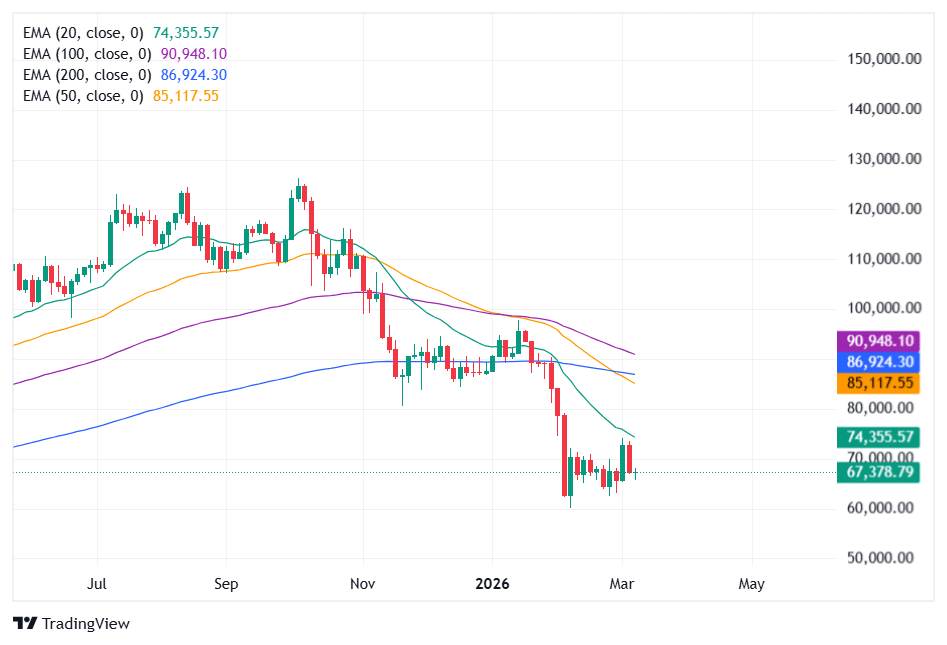
At the time of publishing, Bitcoin’s price was hovering around $67,200—clawing back modest gains after dipping into the mid-$65,000 range overnight. The leading cryptocurrency surged to a high near $74,000 last week but as the weekend approached, it erased all gains.
Bitcoin lingers on historic death cross
The swift recovery, from the $65,000 dip earlier today, comes amid mounting bearish signals on the charts. A prominent death cross has formed on Bitcoin’s 3-day timeframe, the 50-period simple moving average crossing below the 200-period average, for the first time since 2022.

Historical patterns tied to this signal have often preceded the final, painful legs of bear markets, with average drawdowns of 45-52% in cycles like 2018 and 2022.
Notably, Bitcoin has already erased nearly 47% from its 2025 high, and repeated failures to break through resistance in the $69,000–$70,000 zone have reinforced the downtrend. The price sits well below key longer-term levels, including the 200-day EMA in the low-to-mid $70,000s.
In addition, the broader market sentiment also reflects the strain, with The Crypto Fear & Greed Index still sinking within extreme fear territory, dipping as low as single digits recently—a level that has historically marked capitulation phases but also late-stage selling pressure.
While U.S. spot Bitcoin ETFs continue to see inflows (with reports of hundreds of millions in recent weeks), broader catalysts remain absent, and upcoming macro events such as the US CPI release on March 11 and the Federal Reserve meeting later in the month could heighten volatility.
Market spectators note that prolonged uncertainty could amplify de-risking flows, pushing Bitcoin lower in tandem with equities rather than acting as a pure safe haven like gold, which has rallied hard amid the geopolitical turmoil.
Also read: Bitcoin’s 20 Millionth Coin Set to Be Mined This Month