

Key Highlights
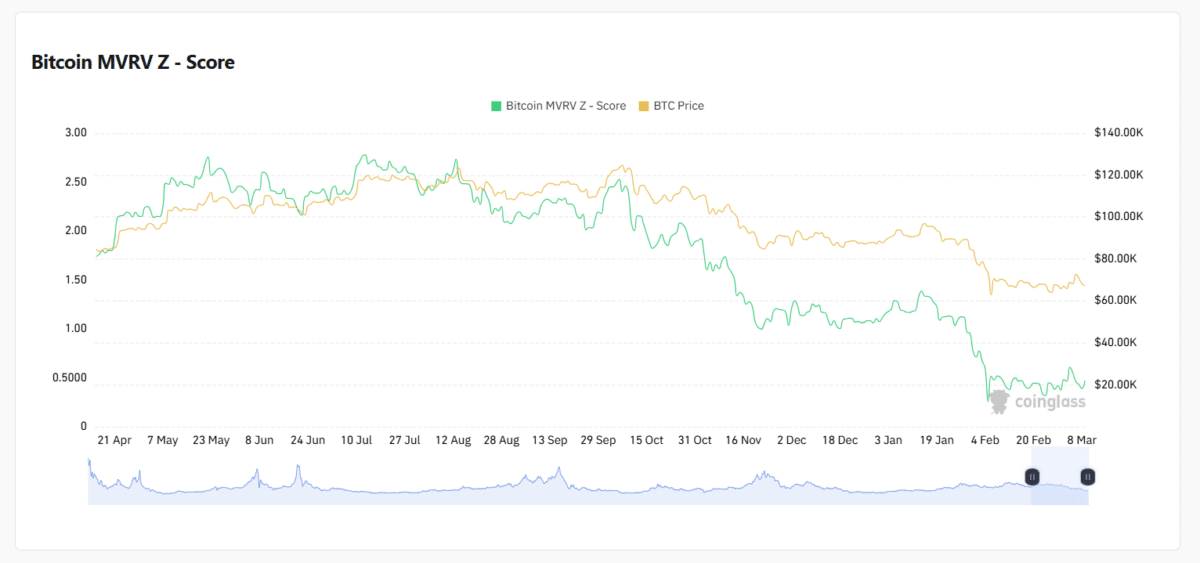
- The Z-Score hovers well below its long-term mean (~1.73–1.89) and far from cycle-top extremes (>5–7), signaling Bitcoin is neither overheated nor in deep capitulation—classic post-peak consolidation after the 2025 high near $126K.
- In prior cycles (2013, 2017, and 2021), spikes above 7 flagged major tops with high accuracy; today’s subdued reading aligns with transitional phases often preceding accumulation or recovery, not imminent euphoria.
- This miner-revenue gauge (currently subdued, sub-1.0 range) echoes the MVRV’s neutrality—no miner euphoria or distress extremes—reinforcing a wait-and-see market regime rather than breakout or breakdown signals.
Bitcoin continues to hover near $70,000, a level that feels almost mundane after last year’s surge to roughly $126,000 in October. Yet beneath the surface, on-chain metrics paint a picture of a market that’s neither euphoric nor in full capitulation.
The standout gauge right now is the MVRV Z-Score, a veteran indicator that has reliably flagged major cycle turns for more than a decade.
According to latest data from Coinglass, the score currently reads around 0.47, while NewHedge shows roughly 0.5 with a recent 20% uptick over 24 hours. These figures place the Z-Score firmly in neutral territory, well below the long-term historical mean near 1.73–1.89 and far from the extreme readings above 5–7 that have historically marked overheated tops.

The metric, calculated as the difference between Bitcoin’s circulating market value and its realized value (the price at which coins last changed hands), divided by the standard deviation of market value.
In past cycles, the MVRV Z-Score has been eerily precise. It spiked into the high single digits during the 2013 mania, climbed sharply ahead of the 2017 blow-off, and peaked near 7–8 in late 2021 before the brutal 2022 bear market.
Those extremes captured unsustainable euphoria where unrealized profits ballooned to levels that invited heavy profit-taking and reversals. The 2025 peak around $126,000 likely saw similar overheating before the drawdown to current levels erased much of that excess.
At today’s subdued reading, the indicator suggests Bitcoin is trading close to its aggregate holder cost basis. This setup echoes transitional phases seen after previous cycle highs: not yet a screaming buy like the deep negative zones of 2015, 2018–2019, or 2022 bottoms, but also nowhere near the red flags of impending collapse.
The modest rebound from earlier 2026 lows (some rolling windows hit record negatives in January) aligns with Bitcoin’s stabilization around $69,000–$71,000, supported by increasing ETF inflows and easing macro pressures like falling oil prices.
Looking ahead, history offers clues about what might come next. When the Z-Score lingers in this low-to-neutral band for extended periods, it often precedes renewed accumulation and eventual recovery rallies, provided catalysts emerge, such as clearer regulatory tailwinds or broader liquidity expansion.
The road ahead for 2026
Market spectators still view 2026 as part of a prolonged “winter” following the 2025 high, consistent with the four-year halving rhythm that has delivered peaks roughly 18 months after halvings. In that framework, further downside toward $50,000–$65,000 remains possible before any meaningful uptrend resumes, potentially delaying the next true cycle peak until 2028–2029.
A closely correlating companion metric is the Puell Multiple, which compares daily miner revenue to its 365-day moving average. Like the MVRV Z-Score, elevated Puell readings (above 3–4 historically) have signaled overheated miner profitability and often coincided with cycle tops, while sub-1.0 levels marked miner distress and bear-market floors.
Currently, Puell sits in subdued territory, reinforcing the narrative that neither euphoria nor panic dominates. When these two indicators align at extremes, they have amplified signals; their joint neutrality now points to consolidation rather than imminent breakout or breakdown.
Bitcoin remains a volatile asset, and no single metric dictates the future. Yet, with the MVRV Z-Score refusing to flash danger, the market appears in a patient, wait-and-see mode—positioned for whatever macro or adoption shift arrives next.
Also read: Winklevoss Twins Move $130M in Bitcoin To Gemini Wallets