

Key Highlights
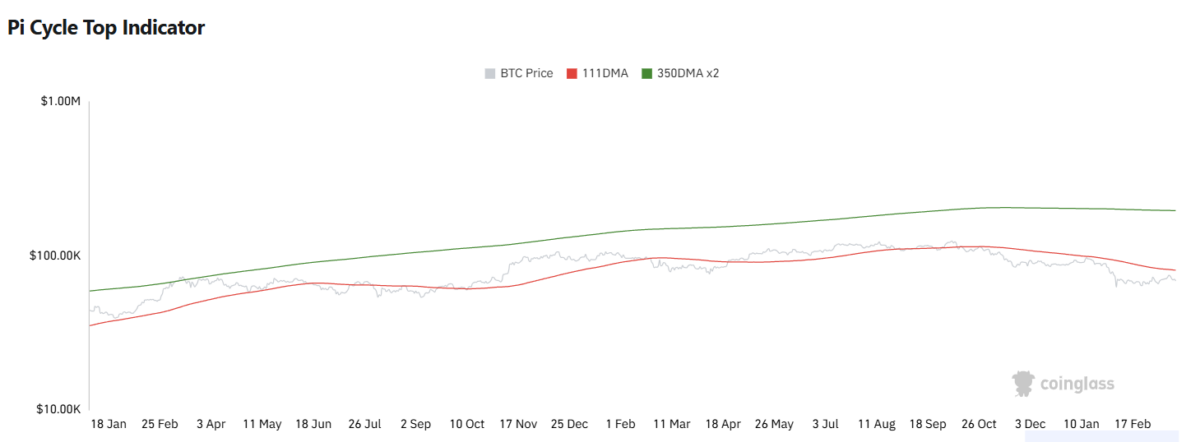
- Pi Cycle Top distant (111DMA ~$80,800 vs. 350DMA×2 ~$197K) — no euphoric peak near; confirms mid-cycle pause, not exhaustion after 46% drop from $126K.
- MVRV Z-Score ~0.48 (neutral, breakeven holders) + Puell Multiple ~0.67 (miner distress) suggest classic setup that eases sell pressure and precedes recoveries in past cycles.
- If $67–68K holds + inflows return, target $80–85K averages by June (possible $90K test); downside risks to $65–75K range-bound if macro weakens, but cycle evolving healthily with institutional support.
As the crypto market is approaching the last week of March and the closing of 2026’s first quarter, Bitcoin lingers like a weathered boxer between rounds.
Currently trading around $68,600 on the scoreboard, the largest cryptocurrency is down roughly 46% from last year’s $126K peak, yet still standing tall with no knockout in sight.
The pullback since late 2025 has been sharp which fits historical post-halving correction patterns but feels drawn out compared to quicker 2021-style resets. Besides, ETF inflows have slowed but not reversed and whale accumulation continues on dips.
At the same time, the miner pressure is evident: average costs remain elevated, and hashrate adjustments reflect some capitulation, which historically lightens supply overhang when price stabilizes. The current average mining costs sit near $88,000, putting many operations underwater at current prices. That dynamic often precedes supply squeezes when price recovers.
Current long-term indicators snapshot
The most popular long-term indicator, Pi Cycle Top, does not reflect any crossover in play. The 111-day moving average lingers around $80,700–$80,900, while the 350-day MA × 2 towers near $197,000—as per Coinglass data.

This wide separation means the classic top signal is distant, which happens when the shorter MA crosses above the doubled longer one. It historically flags euphoric peaks within days; its absence here underscores ongoing consolidation, not exhaustion.
MVRV Z-Score, on the other hand, sits at the neutral ground of 0.48, hugging the lower end of expansion ranges and nowhere near the 7+ blow-off levels of cycle tops. Holders are mostly breakeven or lightly in profit, leaving headroom for growth before overvaluation sets in—though not the deep undervaluation that screams immediate bottoms.
Meanwhile Puell Multiple sits around 0.67, firmly in miner distress territory, well under 1 since late November where daily revenue trails the yearly average.
Low readings like this have eased selling pressure in past cycles, often marking pauses or bases before supply tightens and recoveries build.
Taken together, these leading three metrics show Bitcoin in a familiar mid-cycle grind: hype from the 2024 halving and 2025 ETF surge has faded, but core signals aren’t flashing red for a top.
Outlook for Q2 2026
The current setup leans toward gradual upside through April–June rather than sharp reversal or collapse. If support at $67,000–$68,000 holds and inflows tick higher (ETF resumption, whale buying), expect a push toward $80,000–$85,000 averages by quarter-end, possibly testing $90,000 in stronger months.
The further rally could be pushed on potential macro easing (rate cuts), clearer regulations, or renewed corporate adoption. But downside risks persist as prolonged chop or equity weakness could drag toward $70,000–$75,000 range-bound action, or briefly test $65,000 on risk-off moves.
Market spectators note that the cycle is not fractured, it’s just evolution with more mature capital flows, with miners squeezed, long-term holders dug in, and institutions nibbling. The beginning Q2 could mark the shift from digestion to momentum if indicators keep trending neutral-to-bullish.
Also read: USR Stablecoin Breaks Down After Critical $80M Exploit