

Key Highlights
- A Binance report says Bitcoin’s price tends to fluctuate sharply after oil price jumps before returning to trading based on its own market dynamics.
- ETF inflows, U.S. spot market buying, and corporate purchases absorbed the shock and pushed Bitcoin higher.
Following the recent surge in oil prices caused by tensions in the Middle East, Binance Research, the research arm of the crypto exchange, explained in a report how this has affected Bitcoin’s (BTC) market in the short term.
In the report, titled “The Mechanism of Oil Prices Impact on Bitcoin,” the team said that while Bitcoin price became more volatile in the short term, institutional demand absorbed part of the shock, which helped the cryptocurrency recover quickly.
Bitcoin reacts to oil spikes in waves of volatility
The report explained that Bitcoin reacts to oil price jumps in two stages. First, there is a short period of higher volatility, meaning the price goes up and down more than usual. Then, Bitcoin’s price starts moving based on its own market rules.
“Bitcoin’s response pattern to oil shocks is ‘short-term volatility amplification followed by independent medium-term pricing,’” the research said.
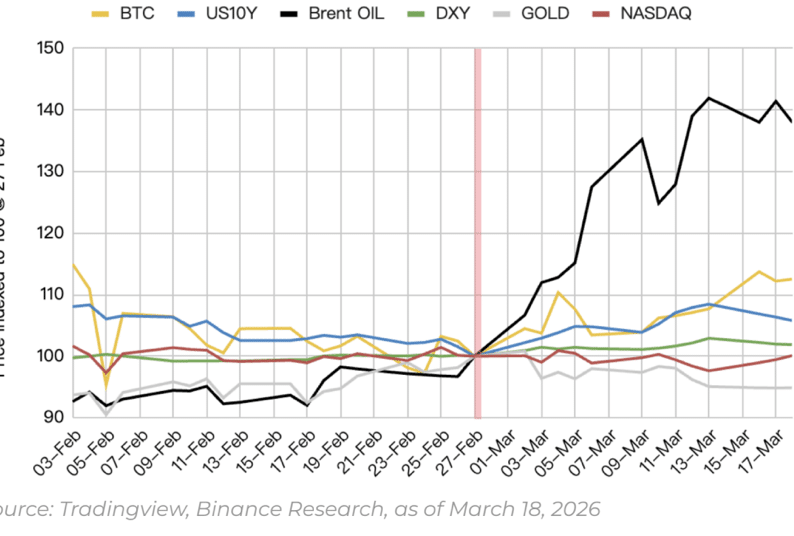
The report noted that both the 2022 Russia-Ukraine war and the 2026 Hormuz crisis showed the same two-stage structure. During the first 1–3 days after the shock, volatility spiked, and then Bitcoin traded according to its own fundamentals.
Between March 2 and March 17, 2026, spot BTC ETFs recorded net inflows of $1.7 billion. This institutional demand, together with buying in the U.S. spot market and corporate accumulation, helped absorb the shock from high oil prices. The research team also stressed that higher oil prices alone do not determine the direction of Bitcoin’s returns.
“Geopolitical oil shocks do not break BTC. Crypto-native systemic credit events do,” the report stated. It added that geopolitical events such as oil-price spikes are more likely to create opportunities for investors to enter the market rather than act as long-term risks.
Bitcoin price movement since oil crisis
The Hormuz crisis caused Brent crude prices to jump from $69 to over $104 in less than three weeks, which is about a 50% increase.
Bitcoin, which had previously declined to around $65,000 from its January 2026 high, fell briefly to an intraday low of $63,047 on February 28 but recovered quickly.
As of today, Bitcoin is trading at $70,834, up over 7.72% in a month since the crisis started.

The report compared this to the 2022 Russia-Ukraine war. During that period, Bitcoin rose 24% in the four weeks after the war. It highlighted that the latter crash was caused by crypto-native events such as Terra/Luna and Three Arrows Capital, not oil prices.
The report concluded that Bitcoin’s price today is mostly affected by purchases from institutional and internal market factors rather than global events.
“Three independent evidence chain – ETF net inflow, Coinbase Premium turning positive, and continued corporate treasury accumulation– document institutional capital executing a counter-cyclical allocation strategy during the crisis,” the report stated.
Also Read: Bitcoin Short-Term Selling Pressure: 92% of Recent Buyers Are in Loss!