

Key Highlights
- Algorand (ALGO) jumps over 45% in a week and 20% in 24 hours, driven by fresh momentum and rising market activity.
- Google Quantum AI paper highlights Algorand’s post-quantum cryptography, while PostFinance and Revolut expand access to millions of users.
- Despite the rally, ALGO remains over 96% below its all-time high, with recent layoffs adding to long-term concerns.
Algorand (ALGO), a Layer 1 blockchain that has been in a long downtrend, saw a sharp spike this week and landed among the top gainers in the market. The move came after several developments hit at once, but the bigger picture around the project tells a more complicated story.
What is Algorand?
Algorand is a Layer 1 blockchain that was founded in 2017 by Silvio Micali, an MIT professor and Turing Award winner. It runs on a Pure Proof-of-Stake (PPoS) consensus and was designed for fast, low-cost transactions with instant finality. ALGO is its native token, used for gas fees, staking, and on-chain activity. The U.S. Securities and Exchnage Commission (SEC) classified ALGO as a digital commodity in March 2026.
That said, Algorand has struggled to keep up with competitors like Solana and Ethereum in terms of user activity and liquidity over the past couple of years. The project has also gone through leadership changes and workforce cuts recently.
ALGO’s price history: A long fall
ALGO launched in June 2019 at an ICO price of $2.40 and hit an all-time high of $3.28 shortly after. It couldn’t hold those levels and dropped below $1 by the end of 2019. The 2021 bull run pushed it to around $2.38, but that was the last time ALGO showed any real strength. Since then, it has been a slow bleed through 2022, 2023, 2024, and into 2025.
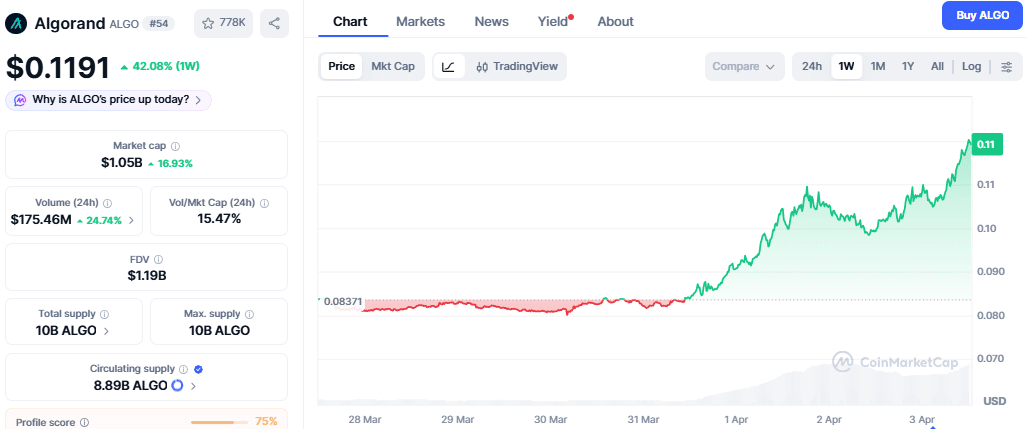
By early 2026, ALGO had fallen below $0.10, and on March 29, it touched an all-time low of $0.080 on CoinMarketCap. That is a decline of over 97% from its peak. Its market cap had dropped below $750 million. Just two weeks before this rally, the Algorand Foundation announced a 25% workforce cut, pointing to tough macro conditions.
So what triggered this week’s rally?
ALGO is currently trading around $0.1191, up 17% in the last 24 hours and over 42% in the past week, placing it among the top-performing assets in the market.
Its market cap has climbed back to $1.05 billion, while 24-hour trading volume has surged to $174.68 million, reflecting a sharp rise in activity and trader interest.
The main trigger was a Google Quantum AI research paper that examined quantum threats to blockchains. Algorand got mentioned 32 times, more than every chain except Bitcoin and Ethereum. Google highlighted its Falcon signatures, state proofs, and quantum-safe smart contracts. The Algorand Foundation posted about it on X, and it blew up.
Around the same time, PostFinance, a Swiss state-owned bank with 2.5 million customers, integrated ALGO on its platform. And Revolut launched ALGO staking for its 70 million+ users. That is a lot of new access, though, whether it actually leads to meaningful demand is another question entirely.
Algorand also reportedly holds about 70% of the RWA tokenization market with $425 million+ in tokenized assets. And Quantoz, a payment company on Algorand, became a Visa Principal Member. However, the RWA space is still relatively small, and this dominance hasn’t moved the price much in the past.
On the technical side, ALGO broke out of a descending channel that had capped it all year. Futures open interest jumped 55% to $58.9 million, and trading volume spiked past $164 million. The broader market helped too, with Bitcoin crossing $69K and money rotating into beaten-down alts.
Even after all this, ALGO remains 96% below its all-time high. Over 80% of holders are still in the red, and momentum indicators like the Relative Strength Index (RSI), which is in the overbought zone, suggest the rally may be stretched. The 200-day Simple Moving Average (SMA), a long-term average price level, is still overhead at $0.138. Whether this turns into a real recovery or just a bounce from rock bottom is something the market will have to figure out on its own.
Also Read: StakeStone (STO) Token Pumps Over 900% Before Brutal 60% Pullback