

Key Highlights
- The stablecoin issuer Tether has set a tight two-week deadline for investors to commit capital in a potential $15–20 billion raise for roughly a 3% stake. Success would place the El Salvador-based firm among the world’s most valuable private companies, alongside OpenAI and SpaceX.
- Tether reported over $10 billion in net profit for 2025 despite a 23% year-over-year decline, while growing its U.S. Treasury holdings to $122 billion direct. USDT circulation hit $186 billion with nearly $50 billion in fresh issuance, driven largely by demand in emerging markets like Nigeria, India, and Ghana.
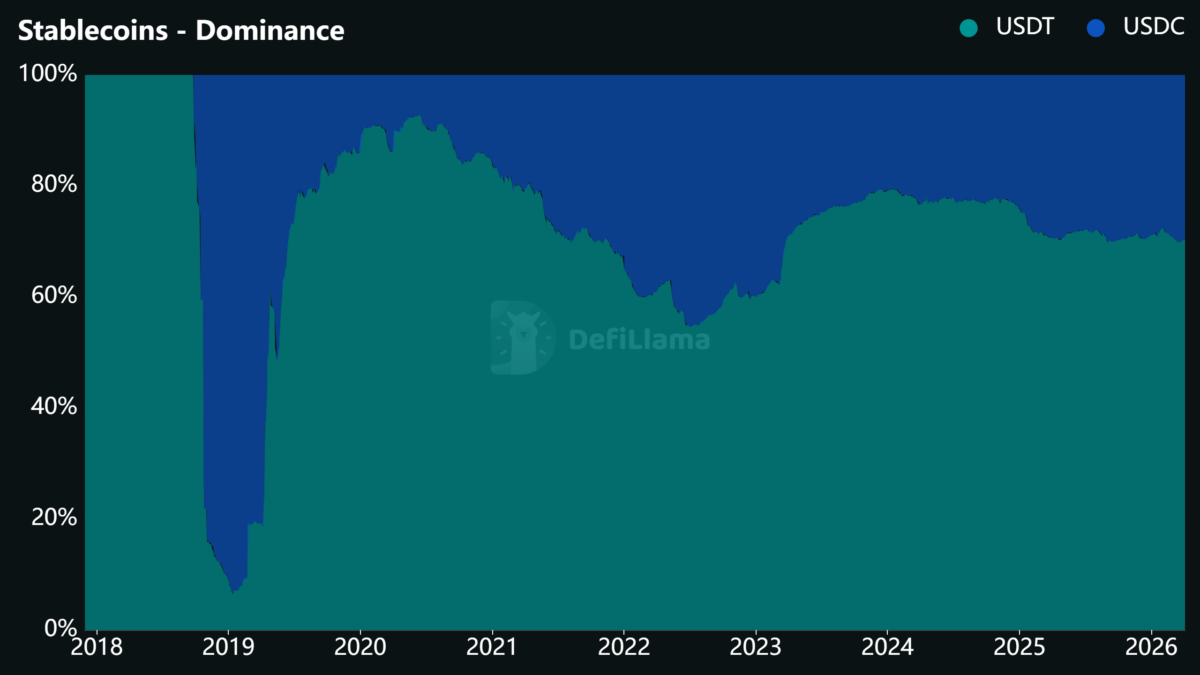
- USDT maintains dominance with ~58–60% market share and unmatched liquidity for trading and remittances, while Circle’s USDC gains ground in on-chain transaction volumes and appeals to institutions. This rivalry underscores Tether’s offshore profit model against Circle’s compliance-focused, public-company approach.
Tether, the company behind the world’s largest stablecoin USDT, is pushing hard to close a massive private funding round that could value it at around $500 billion.
According to a latest report from The Information, executives have given potential investors a tight two-week window to commit capital, signaling the deal is in its final, make-or-break stage.
Reportedly targeting $15 billion to $20 billion for roughly a 3% stake, the raise would catapult the El Salvador-based firm into rarefied air alongside private giants like OpenAI and SpaceX, if successful. The move comes as Tether cements its dominance in crypto payments while facing fresh questions about its sky-high ambitions and opaque structure.
Tether’s financial performance
Financially, the company remains a cash machine, though not quite as explosive as before. Tether posted net profits exceeding $10 billion for 2025, a 23% drop from the previous year’s roughly $13 billion.
Still, that performance arrived alongside record growth in reserves. Tether’s direct holdings of the U.S. Treasuries climbed above $122 billion, with total exposure reaching $141 billion, making the firm one of the largest holders of American government debt globally.
The company’s total assets hit nearly $193 billion against $186 billion in USDT liabilities, leaving $6.3 billion in excess reserves. The total USDT circulation swelled to about $186 billion by year-end, fueled by nearly $50 billion in fresh issuance—as per DeFiLlama data.
Much of the increasing demand for USDT comes from emerging markets where dollar access remains tricky. Nigeria has emerged as a hotspot, with surveys showing high stablecoin ownership and everyday use for payments and savings amid local currency pressures. Similar trends appear in India, Ghana, and other developing economies, where USDT serves as a practical bridge for trade, remittances, and hedging inflation.
The stablecoin race: Tether Vs Circle
While Tether aggressively pursues a $500 billion private valuation, its closest rival Circle operates on a very different playbook. Tether’s USDT still commands the stablecoin throne with roughly 58% market share, while Circle’s USDC has posted stronger growth in on-chain transaction volumes this year.
USDC even surpassed USDT in adjusted volumes for the first time since 2019, and appeals to institutions and DeFi users who prize its full transparency, monthly audits, and U.S.-regulated reserve structure.

The rivalry highlights two visions for crypto’s dollar infrastructure. Tether bets on unmatched liquidity, global reach, and fat profit margins from an offshore model that has drawn past regulatory scrutiny but delivered outsized returns.
Circle, now a public company, emphasizes compliance, institutional trust, and integration with traditional finance, even as it shares more of its reserve income with partners like Coinbase.
As Tether courts high-profile backers for its landmark raise without IPO plans, the contest is sharpening. USDT remains the everyday workhorse for traders and remittances, while USDC gains ground in regulated corridors and on-chain activity.
Whether Tether can justify its lofty valuation will depend in part on how well it defends its dominance against Circle’s steady, regulation-friendly advance.
Investor skepticism on the fundraise plan
While Tether dominates the current stablecoin landscape, its $500 billion price tag has raised eyebrows. Skeptics point to Tether’s continued private status, past regulatory scrutiny, and questions over long-term governance.
Investors are said to be wary of the premium, especially without a clear path to an IPO. CEO Paolo Ardoino has confirmed the company is courting select high-profile backers, possibly to fund expansion into new areas while reinforcing its core stablecoin business.
For now, Tether’s bet is straightforward: its network effects and role as crypto’s default dollar are worth a premium few traditional FinTechs can match. Whether enough capital arrives by the deadline will test just how much the market believes that narrative.
Also read: Charles Schwab Plans Direct Bitcoin, Ethereum Trading Rollout