
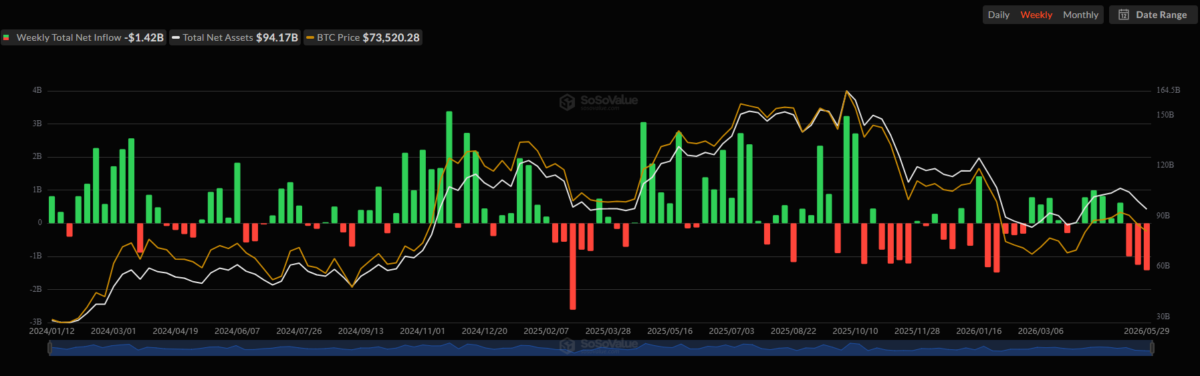

US spot Bitcoin ETFs experienced their largest monthly net outflow of 2026 in May, with investors pulling approximately $2.43 billion from the products.
According to SoSoValue data, the sharp reversal came after promising early-month inflows and reflected broader caution amid Bitcoin’s price volatility and shifting macroeconomic conditions.
As of May 29, cumulative net inflows since the ETFs launched in January 2024 stood at $55.66 billion, while total assets under management (AUM) declined to $94.17 billion.
The May figure marks a significant departure from the positive momentum seen in prior months, underscoring the sensitivity of institutional crypto exposure to market swings. While April delivered roughly $1.97 billion in net inflows, May’s heavy redemptions erased those gains and more, highlighting a classic “sell in May” dynamic playing out in the digital asset space.
Early Inflow Streak Gives Way to Prolonged Outflows
The month began on a strong note for spot Bitcoin ETFs. Investors poured money into the funds during the first week, building on April’s rebound.
With single sessions occasionally exceeding $600 million in combined inflows, this optimism aligned with relatively stable Bitcoin pricing in the $70,000–$80,000 range and lingering hopes for sustained institutional adoption.
However, sentiment shifted dramatically mid-month. A prolonged outflow streak—lasting nine or more consecutive trading days at its peak—quickly overwhelmed initial gains.
SoSoValue-tracked daily figures reveal the intensity of the reversal. Notable negative sessions included outflows of $635 million on May 13, $649 million on May 18, and a particularly heavy $733 million on May 27.
By the final week, daily redemptions continued at a steady pace, with May 28 seeing $223 million and May 29 closing at $125.31 million withdrawn.
Supporting these drastic outflows were several converging factors. Bitcoin faced heightened volatility, struggling to maintain upward momentum amid global risk-off sentiment. While geopolitical conflicts kept the world markets volatile, some large holders appeared to take profits following earlier rallies.
The late-May period alone saw over $2 billion in redemptions across a compressed window, turning what could have been a modestly positive month into the year’s biggest disappointment for ETF flows.
Performance of Major Issuers and Fund-Specific Dynamics
BlackRock’s iShares Bitcoin Trust (IBIT) once again dominated the flows, both positive and negative. The fund led early inflows but shouldered the brunt of later outflows, with reports citing hundreds of millions in redemptions on peak days. Its scale—by far the largest among spot Bitcoin ETFs—makes it a bellwether for overall sector sentiment.

Fidelity’s FBTC and Grayscale’s GBTC also registered notable withdrawals, though smaller funds showed more mixed results.The concentration of activity among top issuers highlights ongoing consolidation in the ETF market. Since their debut, these products have collectively attracted over $55 billion, transforming Bitcoin from a niche asset to one with mainstream financial infrastructure. Yet May’s data reveals the fragility of that momentum.
Grayscale products, in particular, have historically faced redemption pressure due to fee structures and legacy positioning, while newer, lower-cost options like IBIT and FBTC have captured the majority of fresh capital.
Total AUM dropping toward the $94 billion level (from higher mid-month figures) also reflects both outflows and Bitcoin’s own price movements. With the cryptocurrency trading within a broad range rather than breaking decisively higher, many institutional allocators opted to reduce exposure rather than add at current levels.
Broader Market Implications and Outlook
May’s $2.43 billion outflow carries implications beyond the ETF industry itself. It signals that institutional enthusiasm for Bitcoin remains tied to price action and macroeconomic tailwinds.
While the long-term narrative around Bitcoin as a digital gold and inflation hedge persists, short-term flows demonstrate clear sensitivity to interest rate expectations, equity market performance, and geopolitical developments.
Crypto market observers note that such pullbacks are not uncommon in maturing asset classes. Previous periods of heavy outflows have often preceded renewed inflows once conditions stabilize. The fact that cumulative inflows remain strongly positive at $55.66 billion provides perspective—May’s reversal, while the largest of 2026, has not undone the structural shift toward regulated Bitcoin investment vehicles.
Looking ahead, market participants will watch several catalysts. Potential Federal Reserve policy adjustments, clearer regulatory guidance, and Bitcoin’s technical price levels could influence June flows. ETF issuers continue to emphasize the products’ role in diversified portfolios, citing Bitcoin’s historical performance and growing corporate treasury adoption.
For now, May serves as a reminder of crypto’s volatility. Spot Bitcoin ETFs have democratized access for millions of investors, but they have also imported traditional market dynamics—profit-taking, risk management, and sentiment swings—into the ecosystem.
As the products approach their third year since launch, sustaining consistent inflows may depend on delivering both price appreciation and macro stability. While May ended on a negative note, the overall trajectory since 2024 remains one of remarkable capital formation in a once-fringe asset class.
Also read: Kraken Announces First CFTC-Regulated Perpetual Futures for U.S. Traders