
Georgia will begin installing smart meters in the mountainous municipality of Mestia as authorities move to curb illegal cryptocurrency mining that officials say has placed heavy pressure on the country’s electricity network. The measure forms part of a broader government crackdown on unauthorized power consumption after electricity use in the region surged far beyond expected levels, raising costs for consumers and increasing strain on local infrastructure.
Vice Prime Minister Mamuka Mdinaradze said on Sunday that illegal crypto mining has become a serious strain on Georgia’s power system. He said the issue is now affecting how electricity is supplied across parts of the country.
Government figures show that Mestia used about 133 million kilowatt-hours of electricity in 2025. A municipality of similar size would normally consume less than 10 million kilowatt-hours — making Mestia’s actual consumption roughly 13 times the level of comparable Georgian municipalities. Officials say the gap points to large-scale unauthorized consumption.
Authorities estimate the extra usage has caused losses of at least 20–25 million lari (approximately $9.5 million). They also say the pressure on the grid has contributed to power outages, which have disrupted homes, businesses, and tourism activity in the region. Mdinaradze also said the damage extends to ordinary consumers across Georgia: every electricity subscriber pays approximately GEL 1.5 ($0.55) more per month because of hidden mining-related electricity consumption.
Smart meters target excess consumption
Authorities plan to install electricity meters across Mestia and nearby villages as part of efforts to identify unusually high power consumption linked to illegal crypto mining. The government believes the system will help pinpoint where excessive electricity use occurs and reduce pressure on the local power network.
“It must be emphasised here that the sole purpose of the metering installation is to eliminate the illegal and clandestine consumption of electricity,” Mdinaradze said. He added that residents will continue receiving free electricity for normal household needs, while authorities will apply tariffs to consumption that exceeds approved limits.
Law enforcement agencies will support the rollout and monitor compliance during the installation process. The government also warned that authorities will investigate large-scale unauthorized electricity use and take legal action against anyone who obstructs the program.
Crypto growth brings new challenges
The crackdown comes as Georgia continues to expand its involvement in digital assets and blockchain-based payments. In recent months, the government has worked with industry players to test new financial tools aimed at modernizing how money moves across the country.
Tether recently partnered with Georgian authorities to launch GEL₮, a stablecoin linked to the local currency. The project focuses on faster payments and lower transaction costs, while also exploring broader use of blockchain in everyday financial services.
Separately, crypto exchange Bybit introduced a payment card in Georgia that allows users to spend digital assets through existing payment networks. The card also supports Apple Pay and followed Bybit’s acquisition of a local payment license in late 2025.
Global mining enforcement intensifies
Georgia’s crackdown reflects a wider push by authorities in several countries to tackle illegal crypto mining and its impact on power grids. Similar enforcement efforts have also taken place in Russia, where officials recently uncovered a large-scale operation in the Sverdlovsk region.
Russian investigators said they found about 10,000 mining machines hidden inside abandoned industrial sites. Power companies estimated the illegal activity caused losses of nearly 1 billion rubles. Authorities detained three people and opened criminal cases linked to electricity theft and fraud.
Investigators said the operators bypassed official meters and manipulated electricity records while consuming far more power than permitted under their allocation.
Mining activity remains resilient
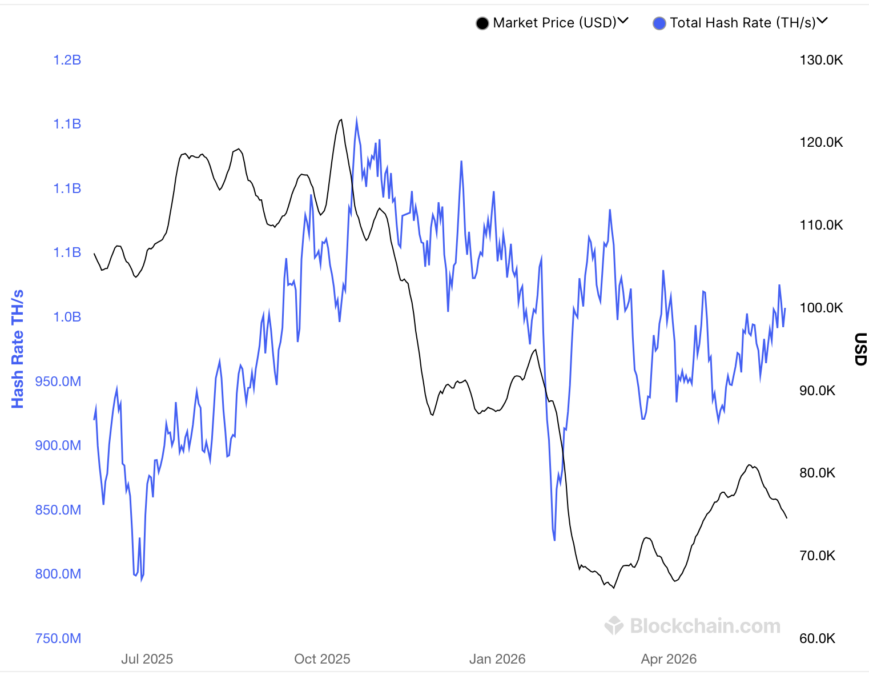
Despite the increase in the effort towards stricter enforcement, Bitcoin mining operations have largely remained steady in global networks. Data indicates a drop in the price of Bitcoin from approximately $110,000 to the $70,000 range from mid-2025 to early 2026, in light of volatility in the cryptocurrency market.

Nevertheless, there was relative consistency in the total hash rate of the network, which hovered between 900 million TH/s and 1.1 billion TH/s. This implies that even with the weakening prices and increased regulatory concerns in some areas, mining operations were consistent.
The data implies that the industry has been consistent in its activities despite the heightened government interest in electricity usage and strain on the power grids by large scale mining.
Also Read: $50M Traded as CME Group Rolls Out 24/7 Crypto Futures Access