
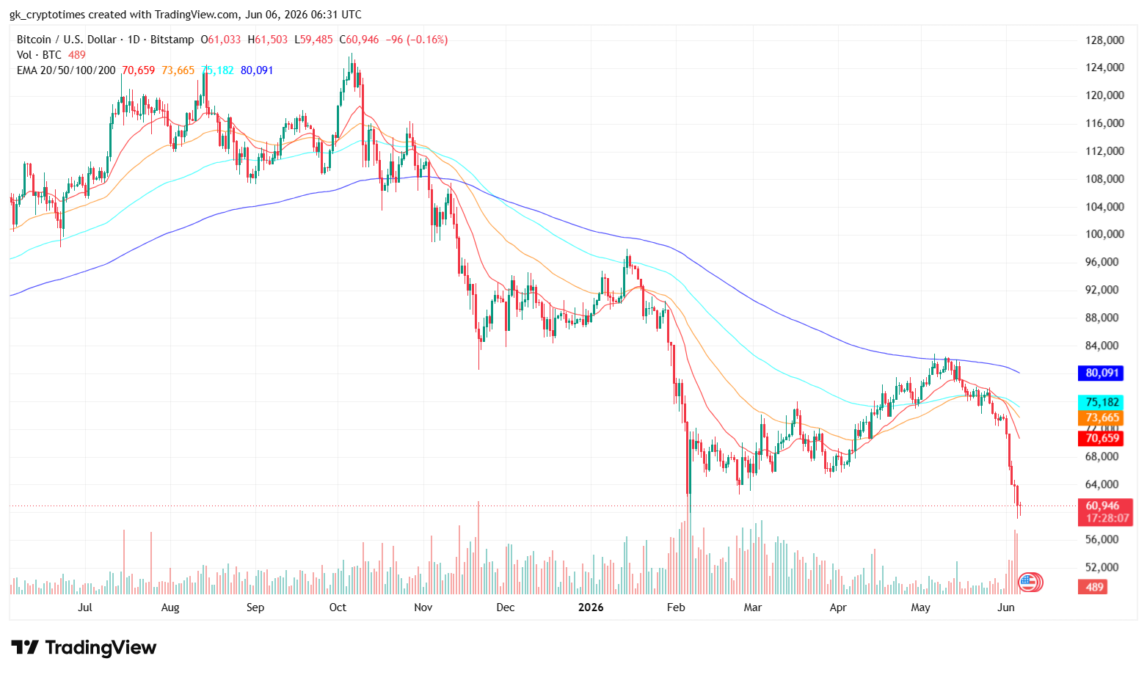

Bitcoin (BTC) dipped below the key psychological price mark of $60K early Saturday, extending losses in its recent market correction. The largest cryptocurrency has shed more than 50% from its October 2025 peak, marking one of its steepest corrections in recent cycles and sparking debate over whether this dip signals deeper trouble or a classic buying opportunity.
As of publishing, BTC hovers near $61,000, down roughly 2% in the last 24 hours with trading volume exceeding $70 billion—which has surged by 30% even as weekend approaches where trading volume cools down. Its market capitalization hovers near $1.22 trillion.
The asset has fallen sharply this week—down 17% in the past 7 days and nearly 25% in the past 30 days—breaching key support levels and triggering billions of dollars in leveraged liquidations.
Drivers Behind the Sell-Off
The latest sell-off follows multiple factors, including pressured and unprecedented outflows from spot Bitcoin U.S. ETFs, with a 13-day streak totaling around $4.4 billion since mid-May. On June 5, 2026 alone, the 11 ETFs posted a combined daily net outflow of $325.69 million, contributing to weekly outflows totaling $1.72 billion.

BlackRock’s iShares Bitcoin Trust led redemptions, contributing heavily to the exodus. This reverses earlier 2026 inflows and reflects institutional caution amid macroeconomic uncertainty.
One of the primary drivers, however, is Strategy Inc. (formerly MicroStrategy), the largest corporate Bitcoin holder, which added fuel to the fire by selling 32 BTC (worth ~$2.5 million) in late May to cover preferred stock dividends—its first sale since 2022. While Strategy still holds over 843,700 BTC (valued over $52 billion), the move rattled sentiment and amplified fears of broader profit-taking.
Coinciding the fears were geopolitical tensions, including U.S.-Iran conflicts that have boosted oil prices and inflation concerns, delaying expected Federal Reserve rate cuts.
“A lot of the momentum that helped push Bitcoin higher earlier this year has slowed, and investors are becoming more selective about where capital goes,” said Daniel Reis-Faria, CEO of ZeroStack, in an exclusive statement shared with The Crypto Times. “When confidence weakens, crypto tends to react quickly because it remains a higher-risk asset for many investors.”
Moreover, stronger-than-anticipated U.S. jobs data further fueled bets on higher-for-longer interest rates, hurting risk assets like Bitcoin. Whales and long-term holders have also distributed coins, with over 6,000 BTC sold in recent sessions.
Market Reaction and Technical Outlook
The decline has wiped out significant leveraged positions, with futures open interest (OI) dropping to $45 billion and funding rates normalizing.
Bitcoin now tests critical support near $60,000, a level many analysts view as psychological. A break below could open the door to $55,000–$48,000, while a reclaim of $65,000–$70,000 would signal short-term relief.
“Talk of Bitcoin falling to $60,000 shows how cautious investors have become after recent price weakness. If sentiment continues to weaken, I wouldn’t be surprised to see Bitcoin test lower levels and reach the $54,000 range,” Daniel emphasized.
Broader crypto markets followed suit, with Ethereum and major altcoins posting double-digit weekly losses. Prediction markets show mixed bets: some traders wager on sub-$50,000 levels in 2026, while others see historical patterns of strong rebounds after 50% drawdowns.
Looking Ahead: Bullish Long-Term Narratives Persist
Despite the pain, many observers remain optimistic. Bitcoin’s halving cycle, institutional infrastructure (ETFs, corporate treasuries), and potential regulatory clarity could drive recovery. Analysts forecast averages between $68,000–$81,000 for June–December 2026 under moderate scenarios, with bullish targets reaching $100,000+ if macro conditions improve.
“Bitcoin can move higher quickly when buying returns, but right now investors seem more focused on managing risk than adding exposure” Daniel added, amplifying, “Until that changes, Bitcoin is likely to remain sensitive to shifts in sentiment and broader market conditions.”
Bitcoin’s current slump reflects classic volatility, amplified by outflows, corporate moves, and macro headwinds. While history shows Bitcoin often emerges stronger from deep corrections, near-term risks remain elevated.
Also read: MicroStrategy Stock Mirrors Bitcoin’s Wildest Swings: 7 Times BTC Moved MSTR