
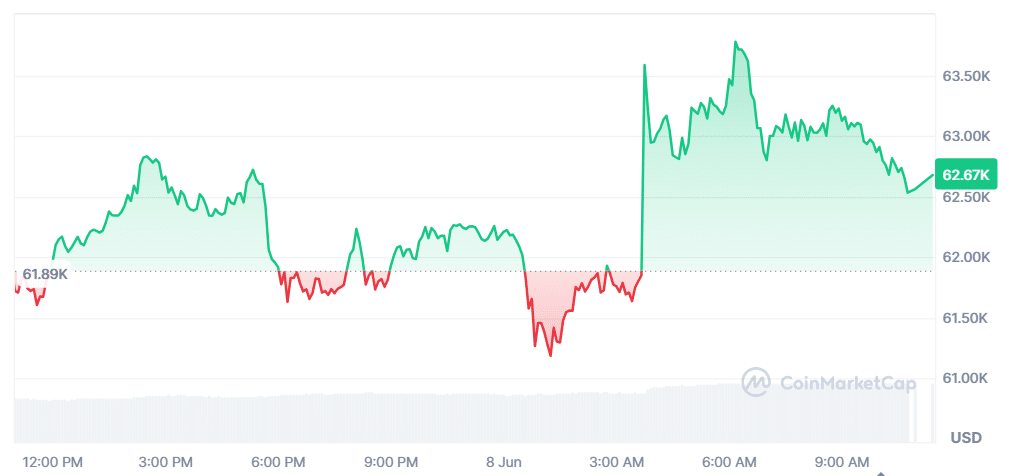

Bitcoin (BTC) is trading in the low-to-mid $62,000 to $63,500 range as of early June 8, 2026, clawing back from the weekend dip to $59,000 in a volatile relief rally that caught many traders off guard.
The cryptocurrency surged nearly 2% in hours, with one notable spike pushing it from around $61,800 toward $63,500. This move comes after one of Bitcoin’s roughest stretches in recent years, highlighting the market’s extreme sensitivity to leverage, institutional flows, and macroeconomic crosscurrents.
The weekend bounce erased some of the pain from a punishing week. Bitcoin posted its worst weekly performance in years, declining roughly 17% and testing multi-month lows.
Over the past month, losses approached 22%, and year-to-date, BTC sits down significantly from its all-time high of $126,198 recorded in October 2025. The largest cryptocurrency’s market capitalization hovered near $1.25 trillion, with 24-hour trading volume sitting at $36 billion.
Drivers of the Recent Sell-Off
This recent sell-off was driven by multiple factors converging to pressure Bitcoin lower. Among all, persistent outflows from U.S. spot Bitcoin ETFs played a central role. Funds experienced over $4 billion in net redemptions across more than 15 consecutive trading days, one of the longest streaks on record.
Adding to the unease was news that Strategy (formerly MicroStrategy), long Bitcoin’s most vocal corporate champion, made its first BTC sale in years. The company offloaded just 32 BTC for approximately $2.5 million to cover preferred stock dividends—a tiny fraction of its massive 843,000+ BTC treasury. Yet the symbolic break from Michael Saylor’s “never sell” doctrine rattled sentiment, especially as the firm navigated preferred stock obligations and a narrowed premium on its shares.
Macro headwinds compounded the decline. U.S.-Iran geopolitical tensions spiked oil prices and inflation fears, delaying anticipated Federal Reserve rate cuts. Strong jobs data further tempered expectations for easier monetary policy. Capital rotated out of crypto into AI and tech-related opportunities, including rumors around high-profile IPOs. High leverage amplified moves, with roughly $7 billion in total liquidations recently and billions more in shorts wiped out during the downturn.
The Spark of the Relief Rally
The sudden spike users observed—lifting BTC from near $61,800 toward $63,500—formed part of a broader short-squeeze dynamic. After plunging as low as $59,100–$59,500, oversold technical conditions (deeply negative RSI readings) and exhausted selling triggered bargain hunting. Over $300–$320 million in short positions liquidated in tight windows, forcing upward momentum and a quick $60 billion lift in total crypto market capitalization.

Hopes of geopolitical de-escalation, including comments from President Trump on potential ceasefires, helped ease risk aversion across assets. Bitcoin held key long-term support near the 200-week moving average, providing a technical floor for the rebound. Analysts noted the move as classic relief-rally behavior in a corrective phase rather than the start of a new bull run.
The market sentiment currently remains mixed. Oversold indicators and multi-month low open interest suggest potential for further short-term stabilization or upside tests toward $65,000–$68,000 resistance. However, broader bearish pressure lingers.
Some analysts warn of additional downside to $55,000, $48,000, or even lower if major supports fail, citing historical cycle patterns and ongoing ETF outflows. Others view the current levels—down over 50% from 2025 peaks—as a healthy correction or cycle bottom, pointing to resilient institutional adoption and long-term fundamentals.
On-chain data shows whales offloading while retail accumulated in spots, creating a divergence. ETF AUM has shrunk notably, but Bitcoin’s scarcity narrative and growing tokenized finance interest continue to underpin bullish longer-term cases. Volatility stays elevated, with liquidations underscoring how leverage can exaggerate both downside and recovery moves.
Broader Implications
This episode underscores crypto’s maturation alongside its persistent volatility. Institutional products like ETFs, once seen as a steady bid, have introduced new dynamics where outflows can accelerate drawdowns. Corporate holders like Strategy remain influential but face scrutiny when deviating from prior strategies. Macro linkages—with equities, rates, and geopolitics—have strengthened, reducing Bitcoin’s isolation as a purely speculative asset.For investors, the landscape demands caution.
For now, the latest relief rally provides breathing room, but without sustained positive catalysts—such as renewed ETF inflows, clearer Fed policy, or de-escalation in global tensions—momentum could fade. Technical traders watch $60,000 as critical psychological support, while bulls eye reclaiming $70,000 as a signal of strength.
Bitcoin’s trajectory in 2026 remains uncertain amid post-halving adjustments and a shifting capital environment. The asset has demonstrated remarkable resilience through multiple cycles, bouncing from deep corrections before. Yet near-term risks of further consolidation or “crypto winter” talk persist if outflows and macro pressures continue.
Also read: New York Judge Halts Bid to Claim 39,000 Dormant Bitcoin Wallets