
Key Highlights
- XRPL is set to introduce five new features next week, pending validator approval.
- The upgrade aims to improve privacy, payments, and token management for businesses and institutions.
- XRP fell 3% in the last 24 hours as the market awaited the upcoming network upgrade.
XRP Ledger (XRPL), an open-source blockchain originally developed by Ripple, is preparing for one of its biggest software updates in recent months, with its new xrpld 3.3.0 software release expected to arrive next week.
In a Friday post on X, Jasmine Cooper, the Head of Product for the company, shared that the upgrade will introduce five new features expected to make the blockchain more useful for businesses and financial institutions that want to issue and use tokenized assets. However, the changes will only go live if XRPL validators vote to approve them.
According to Cooper, the release is not about adding another token or launching a new product. Instead, it focuses on improving how assets already created on XRPL can be used in everyday financial activities.
“XRPL has already proven it can support tokenized assets at scale. Now it’s time to put these assets to use: global transfers, trading, collateralizing, and settling,” Cooper wrote on X.
Five new features coming to XRPL
One of the updates is the Confidential MPT. Cooper explained that this is a feature that gives Multi-Purpose Tokens built on XRPL, a new level of privacy.
Today, many financial companies are interested in public blockchains, but they often need sensitive transaction details to remain private. With this feature, token balances and transfer amounts can stay hidden from the public while still allowing approved parties, such as auditors or regulators, to review transactions when necessary. This means businesses can protect private financial information without giving up transparency where it is required.
The update is also expected to bring the Batch feature, which will reportedly allow up to eight different transactions to be completed together in one operation. Instead of processing each transaction separately, they are grouped into a single package. If one transaction fails, the others will not go through either.
This is expected to help reduce the risk of one side completing a deal while the other side does not, making complex financial transactions more reliable.
Another improvement is Permission Delegation, which is designed for organizations where different teams have different responsibilities. Rather than giving every employee full control over important accounts, institutions can assign limited permissions for specific tasks.
For example, a treasury team can safely keep control of important account keys while allowing another department to carry out approved transactions. This creates a clearer separation of duties without reducing security.
The fourth feature, Sponsored Fees and Reserves, removes one of the barriers that new users often face on XRPL. Normally, every participant needs XRP to pay transaction fees and meet account reserve requirements before using the network. Under the new system, another party, such as a bank, token issuer, or platform, can cover those costs on behalf of users. This could make it much easier for businesses to introduce customers to blockchain services without asking them to buy XRP first.
The final amendment, Dynamic MPT, gives token issuers more flexibility after creating a token. At present, making changes to a token’s settings may require issuing an entirely new token and asking holders to migrate. With Dynamic MPT, issuers can update approved properties, such as transfer fees, metadata, or other supported features, if those options were allowed when the token was first created. This makes it easier for projects to respond to changing business needs or new regulations without disrupting users.
Validators must approve the changes first
Cooper said the release is currently expected next week, but the amendments will not become active until XRPL validators approve them.
Validator operators have been encouraged to review each proposal before voting. Ripple also said technical documentation is available through its open-source website, with more implementation guides and security reviews expected in the coming weeks.
XRP price dips ahead of the upgrade
Meanwhile, this comes as XRP, the native token of the Ripple ecosystem, suffered a 3% drop in the last 24 hours. In fact, the token has been consolidating throughout the month of July, moving between $1.18 and a low of $1.03.
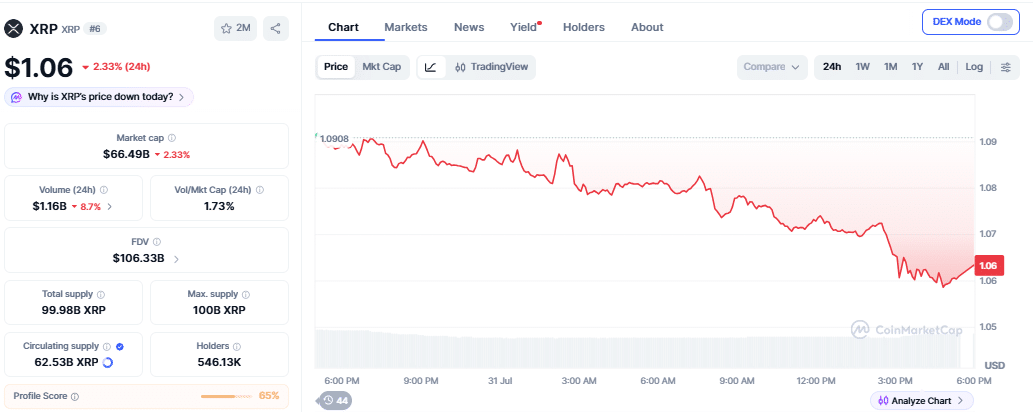
At the time of reporting, XRP is trading for $1.06 from an intraday high above $1.08 as trading activity slowed heading into the weekend. Its market cap has also dropped by 2.43% to around $66.45 billion, and its trading activity has also reduced by 8.65% over the last 24 hours to around $1.16 billion in volume. However, things might change for the token next week as the community awaits the upgrades.
Also Read: XRP Price Prediction August 2026: Can XRP Reach $1.5?