

Key Highlights
- The crypto market dropped, with Bitcoin below $70,000 and Ethereum at $1,981, as investors reacted to Trump’s Iran threat.
- Trump said the U.S. may target new areas and groups in Iran, escalating the week-long U.S.-Israeli military action.
- The conflict has disrupted energy markets and flights, raised oil and gas prices, and caused over 1,300 deaths in Iran.
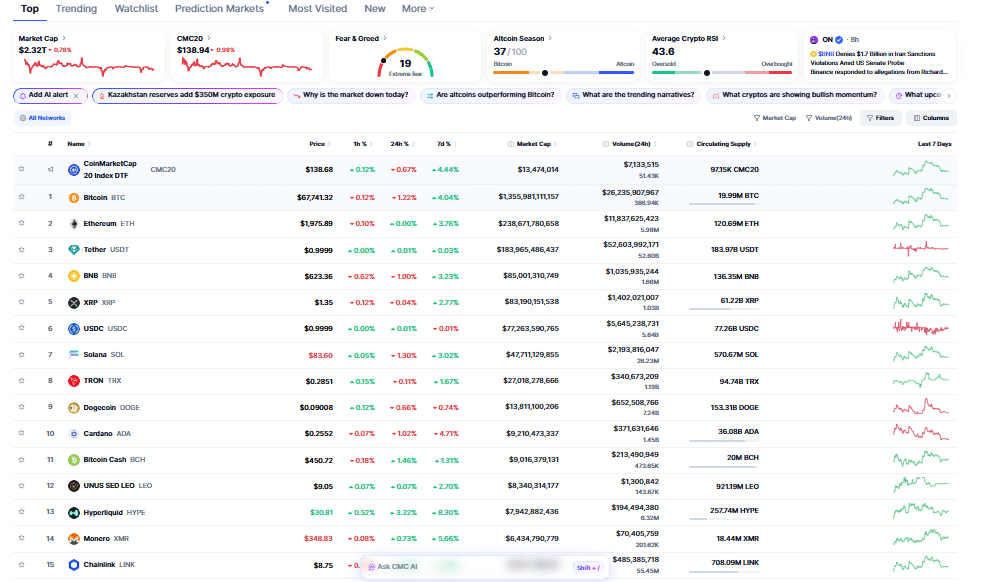
The crypto market is in red today following new developments amid the ongoing war in the middle east. As of the time of writing, the total crypto market valuation is down by 0.86% to about $2.32 trillion.
The selloff followed a post by Trump on Truth Social in which he said the U.S. is considering ‘complete destruction and certain death’ of previously untargeted areas and groups in Iran, escalating the military campaign that followed the death of Iran’s Supreme Leader.
Following this, Bitcoin price fell below $70,000, this is slightly down 0.63% in the last 24 hours. Ethereum also dropped from a daily high of $1,995 to now trading for $1,981. In fact, the Fear & Greed index is currently at 19, which suggests that traders and investors are extremely cautious of the market at the moment.
Escalating war between U.S. and Iran
One his social media, Truth Social, the U.S. president said that Iran would be “hit very hard” and said the U.S. was considering “complete destruction and certain death” of areas and groups that had not been targeted before.
He added, “Today Iran will be hit very hard! Under serious consideration for complete destruction and certain death, because of Iran’s bad behavior, are areas and groups of people that were not considered for targeting up until this moment in time.” He added.
He also said Iran is “no longer the ‘Bully of the Middle East,’ they are, instead, ‘THE LOSER OF THE MIDDLE EAST,’ and will be for many decades until they surrender or, more likely, completely collapse.”
The statement marks a notable escalation in tone. The U.S.-Israeli military operation began roughly a week ago following the death of Iran’s Supreme Leader Ayatollah Ali Khamenei. Since then, the campaign has expanded across multiple fronts, drawing international concern.
Iran responds, regional tensions deepen
Iran’s interim leadership, including Masoud Pezeshkian, responded by saying the country would not attack any nation that has not attacked Iran first. Even so, drones and missiles were launched toward Qatar and Bahrain, according to the semi-official Tasnim news agency. Pezeshkian stated, “The idea that we would surrender unconditionally — they must take such a dream to the grave.”
The war has already caused over 1,300 deaths in Iran and dozens more in the region. Israeli airstrikes in southern Beirut and ground operations in Lebanon have killed at least 120 people, targeting Iran-aligned Hezbollah fighters. Six U.S. troops died during the first two days of fighting.
Broader Market Impact
The conflict continues to ripple through global markets beyond crypto. Oil prices remain elevated above $90 per barrel, driven by fears of supply disruption in the Strait of Hormuz — a chokepoint for roughly 20% of global oil transit. Polymarket data shows a 66% probability that Iran will attempt to close the Strait by March 31, with the contract drawing over $7.5 million in trading volume.
Flights across the Middle East have been disrupted, and energy markets remain on edge. The combination of rising oil prices and geopolitical uncertainty has complicated the Federal Reserve’s rate-cut outlook, adding further pressure to risk assets including cryptocurrencies.
The financial market, especially the crypto market, was affected by the war. For instance, Bitcoin price dropped as low as $60k last Sunday, March 1, due to the war, before recovering back above $70k on Thursday.

In addition, about $124 million has been liquidated from the market due to the drop in prices, affecting 65,828 traders. According to Coinglass, $92 million from the amount came from traders that had bet on prices going up, while $31 million came from short position traders.
Bitcoin ETF flows had provided some support earlier in the week, with ETFs recording approximately $1.45 billion in net inflows over five trading days, according to Farside Investors data. Whether those flows hold in the face of renewed geopolitical escalation will be a key signal heading into next week.
Also Read: Nearly Half of All Bitcoin Is Underwater, Glassnode Flags Warning