

Key Highlights
- VDOR surged over 130% in seven days, coinciding with a sharp rise in oil prices during the Strait of Hormuz crisis and increased retail interest.
- Analysts say the rally is driven by narrative momentum and thin DEX liquidity, with price movements disconnected from actual oil market fundamentals.
- The token lacks verified oil backing, team transparency, and real utility, raising concerns about sustainability and potential downside risks.
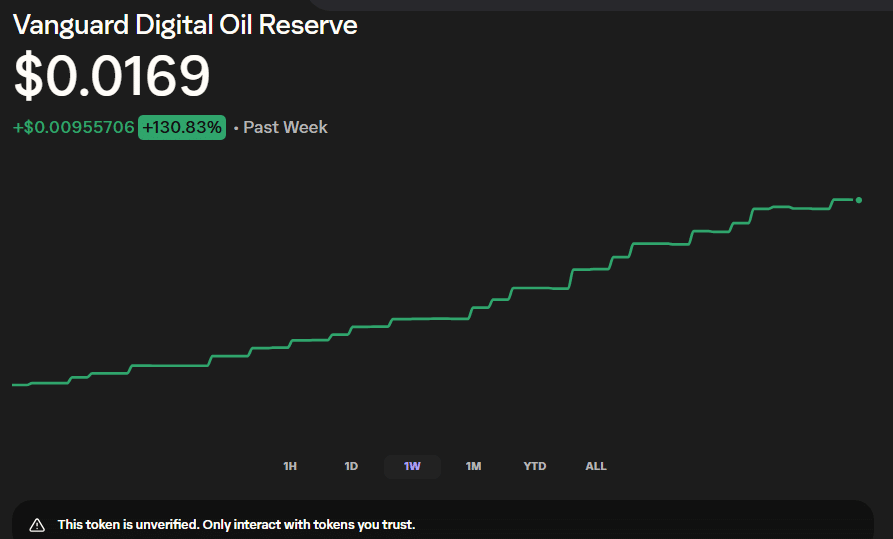
Vanguard Digital Oil Reserve (VDOR), a Solana-based memecoin riding the oil crisis wave, has surged over 130% in the past seven days. The token went from trading around $0.0067 at the start of the week to hitting $0.0169 as of March 31, 2026. That is a massive move for a token that most people had not even heard of two weeks ago.
What is VDOR?
VDOR, or Vanguard Digital Oil Reserve, is a Solana-based SPL token that launched in late 2025. It positions itself as a tokenized representation of oil market dynamics. The project markets itself as an “on-chain energy reserve” and claims to offer exposure to the oil sector through blockchain rails.
However, it is important to note here that VDOR has no verified backing by physical oil reserves. There is no oracle mechanism connecting its price to WTI or Brent crude benchmarks. The team behind the project remains anonymous, and the token has no confirmed partnerships with any institutional players. Despite the name sounding like something from the Vanguard Group, the $9 trillion asset management firm has absolutely no affiliation with this token.
In simple terms, VDOR is a narrative-driven memecoin that benefits from the oil headline cycle. When oil is in the news, VDOR catches the attention. When the headlines fade, so does the buying pressure.
The Price Action: From $0.0067 to $0.0169
At the start of the week, around March 24, VDOR was trading at approximately $0.0067 with a market cap sitting near $7 million and a daily trading volume of roughly $276,000. The token had around 6,570 holders at that point and was relatively unknown outside of the Solana memecoin community.
Fast forward to March 31, and the picture looks completely different.
VDOR is now trading at $0.0169, which puts the weekly gain at roughly 130% to 142%, depending on the exact entry point. The market cap has jumped to $17 million. The 24-hour trading volume has exploded to $2.6 million. The number of holders has grown to 28,864. Daily trades have hit 21,684 with over 3,291 unique traders active in the last 24 hours.
The token also hit its all-time high of $0.01608 on March 29 before pushing slightly past that level. The total supply remains fixed at 1 billion tokens, all of which are already in circulation. There is no upcoming unlock or inflation pressure from the supply side.
Why did VDOR price pump? The Hormuz oil crisis connection
The single biggest reason behind this rally is the ongoing Strait of Hormuz crisis.
The final week of March 2026 produced some of the most intense oil market headlines in years. Here is a quick timeline of what happened:
On March 25, Trump signaled possible Iran talks, and oil briefly dipped with WTI near $87. The very next day, Iran rejected direct U.S. negotiations, pushing WTI to $92. On March 27, Iran rejected a reported 15-point peace plan, and WTI hit $99.64 with a 5.46% single day gain.
By March 28, oil closed at its highest level since Russia’s invasion of Ukraine in 2022, with Brent touching $112.57. And then on March 30, Iran accused the U.S. of preparing an invasion, and Brent crude topped $116 per barrel.
The world has now lost an estimated 4.5 to 5 million barrels per day of oil supply due to the Hormuz blockade. That is roughly 5% of global production. Some analysts estimate this could double by mid-April.
In this kind of environment, anything with “oil” or “reserve” in its name starts capturing retail search traffic. Google searches for terms like “oil crypto,” “oil-backed token,” and “vanguard digital oil reserve” spiked hard during this period. VDOR sat right at the intersection of institutional-sounding branding and a trending macro narrative.
But here is the thing. VDOR does not actually track oil. It tracks oil headlines. Earlier in March, analysis showed that VDOR rallied 70% while oil prices were flat, and it barely moved when oil dropped 22%. The price moves based on narrative momentum and DEX liquidity dynamics, not on commodity fundamentals.
This is not the first time this pattern has played out, either. VDOR is the second oil-themed Solana memecoin to spike on Google Trends in March 2026, following UGOR (United Global Oil Reserve), which saw a similar pump and dump cycle earlier in the month.
Low liquidity driving price swings
The chart pattern on VDOR shows what experienced traders call a “staircase” pattern. This means the price sits flat for extended periods, then suddenly jumps vertically to a new level with no gradual accumulation in between. This kind of pattern is typically associated with coordinated buying on thin DEX liquidity rather than organic demand growth.
With DEX liquidity estimated at just $300,000 to $500,000, the entire rally from $0.007 to $0.0169 could have been produced by as little as $50,000 to $100,000 in coordinated buying over seven days. That is not a lot of money to move a market cap by $10 million.
The token has no product, no named team, no audit, and no fundamental utility beyond the narrative it rides. Multiple analysts and publications have flagged red flags around the project, including the deliberately institutional-sounding name that has no connection to the actual Vanguard Group.
Earlier this week, The Crypto Times reported on VDOR’s initial surge, noting that the token had already risen over 100% to around $0.0096, with a market capitalization of approximately $9.6 million and trading volume near $829,000. The report also highlighted that VDOR ranked among the top 10 active memecoins on Phantom at the time.
It further drew comparisons to the WAR token, another Solana-based memecoin that saw gains of over 200% within a week, driven largely by geopolitical narratives linked to the Middle East conflict.
Bottom line
VDOR has given early holders a massive 130%+ return in just one week. The rally has been fueled entirely by the oil crisis narrative as geopolitical tensions around the Strait of Hormuz continue to escalate. The token now sits at a $17 million market cap with significantly increased trading activity and holder count compared to where it started the week.
But none of the fundamentals have changed. There is still no oil backing, no team transparency, and no product beyond the token itself. The price moved because the narrative was loud, not because anything about the project improved.
As always, this is not financial advice. DYOR before putting any money into assets like these.
Also Read: Pump, Dump, Rebound? SIREN’s 65% Crash and 100% Recovery in 48 Hrs Explained