

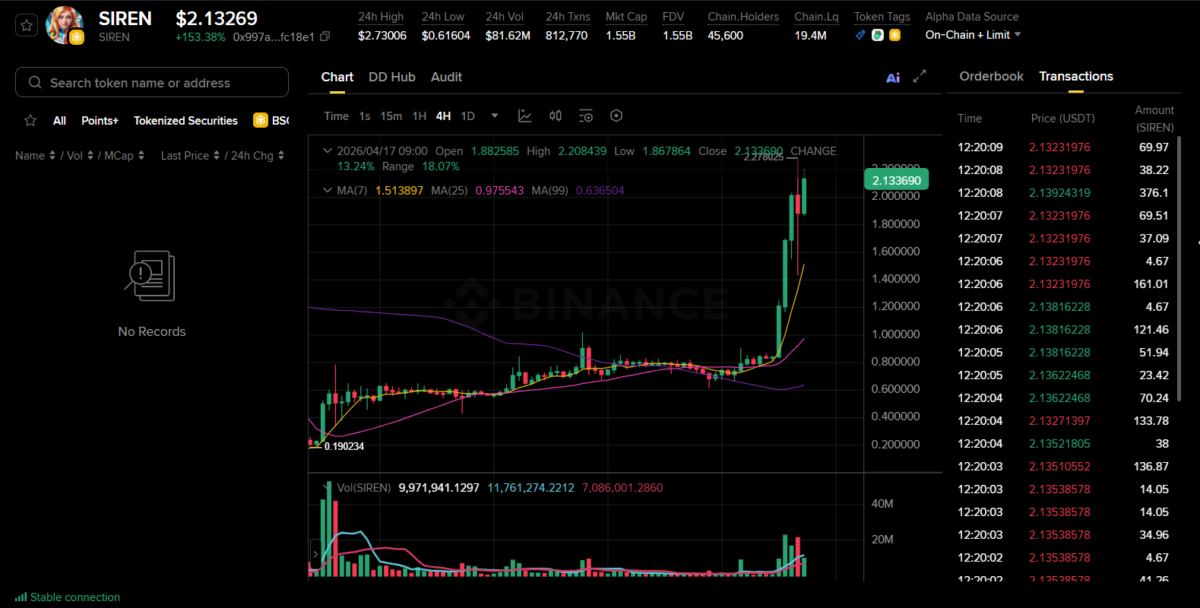
SIREN, the AI-agent memecoin native to BNB Chain, has staged a sharp 24-hour comeback, climbing roughly 150.92% to retake the $2.10 handle and push its market capitalization to $1.52 billion, according to CoinMarketCap data recorded on April 17, 2026.
The move comes on the back of $201.22 million in 24-hour trading volume, a 374% spike, and carries the token to rank #48 on the global cap table.

The rally is the latest chapter in one of 2026’s most controversial crypto stories. SIREN has now delivered a reported 4,598% return over the trailing 12 months, but the path has been anything but linear: the token printed an all-time high of $3.61 on March 22, crashed more than 80% in the following week, and has spent April carving out a higher-low structure that bulls now claim has broken to the upside.
Siren token market snapshot
Spot metrics at the time of publication paint a clear picture of a token in full reflexive rally mode, with high volume, thin liquidity, and a turnover ratio well above healthy mid-cap norms.
| Metric | Value (as of April 17, 2026) |
|---|---|
| Price | $2.10 (intraday high ~$2.24) |
| Market Cap | $1.52 Billion (+150.92% in 24h) |
| CoinMarketCap Rank | #48 |
| 24h Trading Volume | $201.22 Million (+374.4%) |
| 1-Year Performance | +4,598.83% |
| Circulating Supply | 727.27M SIREN (72.7% of max supply) |
| Max Supply | 1,000,000,000 SIREN |
| Holders | 45,540 |
| Liq/Mkt Cap Ratio | 1.27% (thin float — risk flag) |
| Community Sentiment | 63% Bullish / 37% Bearish (30.8K votes) |
Whale accumulation: Binance proxy wallets move millions
The striking on-chain signal behind the move is a steady drumbeat of large transfers out of a Binance-controlled smart-contract proxy wallet (EIP-1967 pattern) into a cluster of addresses tagged by Arkham Intelligence as “SIREN Whale” — 0x1f9, 0xB42, 0x303, 0xE63, 0xe04, and 0x012, among others. In the six-day window leading up to the current pump, these wallets absorbed more than 8 million SIREN, worth an estimated $7 million at prevailing prices.
The most recent transfer, logged one hour before this report, saw 794,509 SIREN (~$1.34 million) route from the Binance proxy to a fresh whale address (0x1f9). This single hop alone is larger than the entire 24-hour depth at ±2% on Binance Alpha’s order book, reflecting how lopsided the structural float has become.
| Time Ago | From → To | SIREN Amount | USD Value |
|---|---|---|---|
| 1 hour | Binance Proxy → Whale 0x1f9 | 794,509 | $1.34M |
| 13–16 hours | Binance Proxy → Whale 0xB42 | 676,433 (combined) | ~$610K |
| 1 day | Binance Proxy → Whale 0xB42 / 0x303 | 2.6M+ (combined) | ~$2.1M |
| 2 days | 0x2371… → Whale 0x012 | 533,524 | $399.44K |
| 3 days | Binance Proxy → Whale 0xE63 | 2.3M+ (combined) | ~$1.82M |
| 6 days | Binance Proxy → Whale 0xe04 | 1.24M+ (combined) | ~$911K |
Accumulation of this kind is typically read two ways. The bull case: sophisticated buyers are pulling supply off exchanges, compressing the free float, and setting up for continuation. The bear case, and the one on-chain analysts have been louder about, is that the same cluster that controls ~88% of the circulating supply is simply rotating tokens between sub-wallets to simulate organic demand.
Where the volume is printing
SIREN’s liquidity footprint is heavily BNB-ecosystem-weighted. Binance Alpha and Gate together account for more than half of all 24-hour volume, while DeFi venues PancakeSwap v3 and Uniswap v4 on BSC add another $30 million in on-chain flow.
| Exchange | Pair | Price | Depth (±2%) | 24h Volume |
|---|---|---|---|---|
| Binance Alpha | SIREN/USDT | $2.13 | $2.3K / $17.4K | $52.69M |
| Gate | SIREN/USDT | $2.11 | $5.5K / $12.2K | $47.46M |
| KuCoin | SIREN/USDT | $2.07 | $7.6K / $7.3K | $24.91M |
| PancakeSwap v3 (BSC) | SIREN/WBNB | $2.13 | — | $17.26M |
| Uniswap v4 (BSC) | USDT/SIREN | $2.13 | — | $13.39M |
| MEXC | SIREN/USDT | $2.07 | $353 / $6.3K | $6.18M |
Depth figures represent order-book liquidity within ±2% of mid-price.
A red flag worth flagging: the Liq/Mkt Cap ratio sits at just 1.27%. For a token with a $1.52 billion market cap, available on-exchange liquidity is roughly what one would expect from a $20 million microcap. This mismatch is precisely what allowed the token’s late-March blow-off, and it is why risk desks continue to treat SIREN as a size-constrained instrument regardless of headline market-cap rank.
The backstory: AI-agent narrative meets concentrated supply
SIREN markets itself as an AI-agent protocol built around a dual-persona chatbot, the cautious “Golden Persona” for contract-risk screening and the aggressive “Crimson Persona” for high-conviction trade ideas, scanning BNB Chain, Solana, and Base for whale activity and sentiment shifts. The project received $200,000 in BNB Chain liquidity support after its Binance Alpha listing and crossed 50,000 holders by mid-2025.
Its breakout moment came in February 2026, when Binance co-founder Changpeng Zhao burned a portion of SIREN tokens held in a donation wallet he had received. The burn triggered a supply-shock narrative that lifted the token from sub-$0.17 to an eventual high above $3.60 within six weeks.
However, the rally also attracted scrutiny. On-chain analyst Yu Jin reported in late March that 52 of the top 54 SIREN holder addresses appeared to belong to a single entity, controlling 644 million tokens, roughly 88.5% of the circulating supply, with market maker DWF Labs named as a suspected controller. DWF Labs has previously denied similar manipulation allegations in other tokens. Independent analytics platforms Bubblemaps and Arkham corroborated the concentration finding.
Derivatives pressure and short-squeeze mechanic
Futures positioning has been a key accelerant throughout SIREN’s 2026 run. Open interest recently touched $106.53 million, with funding rates oscillating between extreme positive and extreme negative prints, a signature of crowded, reflexive positioning rather than conviction-based trading.
During the token’s March peak, more than $7 million in short positions were liquidated on Binance and Bybit as the price vaulted past $3. A single controlling wallet was later observed selling ~500,000 SIREN into the top and buying back ~1 million at lower levels, a textbook distribute-and-reaccumulate pattern that left retail shorts carrying the losses.
CoinMarketCap’s community sentiment poll currently reads 63% bullish against 37% bearish across 30,800 votes. However, derivatives analysts note that rallies fuelled primarily by short squeezes rather than spot accumulation tend to mean-revert sharply once forced-buying exhausts.
Key levels and what traders are watching
- Immediate resistance: $2.24 intraday high. A clean daily close above would open the door to $2.50 and a retest of the March $3.61 ATH.
- Critical support: $1.55–$1.60 — the consolidation shelf that held through early April. A loss of this zone would likely trigger the same deleveraging cascade seen at the March peak.
- On-chain tripwire: Any large outbound transfer from the top whale cluster back to Binance proxy wallets would signal distribution and historically has preceded 60–80% drawdowns within 48 hours.
- Catalysts ahead: The project’s roadmap lists the SIREN DEX and AI Trading Agent as “Coming Soon.” Delivery — or the lack of it — will likely determine whether this cycle’s bid survives past summer.
The Crypto Times’ take
SIREN’s 150% print is real, the volume behind it is real, and the whale accumulation pattern visible on Arkham is a genuine, if ambiguous, on-chain signal. What is equally real is the supply concentration that has defined this token from day one.
Traders taking exposure here should size positions against the 1.27% liquidity-to-market-cap ratio, not the $1.52 billion headline number. In a token where one cluster controls the float, the exit is always narrower than the entrance.
Also Read: ORDI Surges Over 70% in 24 Hours: Bitcoin’s First BRC-20 Token Tops Trending Charts