
In the span of just 18 days in April 2026, decentralized finance (DeFi) lost more than $606 million to hacks and exploits across at least a dozen incidents. Two attacks alone—the $285 million breach of Solana-based perpetuals DEX Drift Protocol on April 1 and the $292–293 million drain of Kelp DAO’s rsETH on April 18–19—accounted for roughly 95% of the month’s total losses.
What started as a targeted social-engineering operation snowballed into a systemic contagion: unbacked liquid restaking tokens (LRTs) flooded lending markets, triggered 100% utilization spikes and bad debt estimated between $124 million and $230 million, forced massive withdrawals exceeding $6–13 billion in DeFi TVL, and prompted emergency freezes across protocols. By April 23, even the world’s largest stablecoin wasn’t spared—Tether froze $344 million in USDT on Tron at the request of U.S. law enforcement.
April 2026 has already surpassed any prior month for DeFi losses since February 2025’s Bybit breach, with total 2026 year-to-date hacks now approaching $772 million. This wasn’t a random streak of misfortune. It was a textbook cascade exposing the interconnected risks of cross-chain bridges, LRT composability, human-operated governance, and the uncomfortable reality that “decentralized” systems often fall back on centralized emergency powers when the stakes are existential.
The Opening Salvo: Drift Protocol and Lazarus Group’s Long Game (April 1)
The month opened with what many initially dismissed as an April Fools’ prank. On April 1, Drift Protocol—a leading Solana perpetual futures exchange—lost approximately $285 million in roughly 12 minutes. Attackers drained multiple vaults holding USDC, WETH, JLP tokens, and other assets through compromised administrative privileges and pre-signed durable nonce transactions. No core smart contract bug was exploited; instead, the breach stemmed from a six-month social-engineering campaign traced to North Korea’s Lazarus Group (also known as UNC4736 or TraderTraitor).
Lazarus operatives reportedly infiltrated Drift’s contributors via fake identities, conference meetups, and malware targeting cloud infrastructure and personal devices. Once inside, they leveraged multisig governance weaknesses to execute the drainage. Drift immediately paused deposits and withdrawals, and on-chain analysts like PeckShield and Elliptic quickly flagged the North Korean connection—patterns consistent with prior state-sponsored operations, including the use of Tornado Cash for laundering.
The hack set a grim tone, but few anticipated the domino effect it foreshadowed. It highlighted a persistent DeFi vulnerability: even audited protocols with strong on-chain security remain exposed to off-chain human and operational risks.
Mid-Month Bridge Warning Shot: Hyperbridge’s Forged Message and 1 Billion Fake DOT (April 13)
Just twelve days after the Drift incident, another bridge vulnerability surfaced that, while smaller in realized losses, sent shockwaves through the interoperability space and foreshadowed the larger rsETH disaster to come. On April 13 at approximately 03:55 UTC, an attacker exploited a vulnerability in Hyperbridge’s Token Gateway contract on Ethereum—the interoperability layer connecting Polkadot to EVM chains. The root cause was a missing bounds check in the Merkle Mountain Range (MMR) proof verification logic within the two-year-old HandlerV1 contract. This flaw allowed the attacker to forge a cross-chain message that bypassed state-proof validation.
The forged message granted the attacker administrative control over the bridged DOT (ERC-6160) token contract. In a single atomic transaction, they minted 1 billion bridged DOT tokens—vastly exceeding the legitimate circulating supply of roughly 356,000 at the time. The attacker then routed the tokens through Odos Router and Uniswap V4 pools, extracting approximately 108.2 ETH (initially valued at ~$237,000–$272,000).
Hyperbridge initially reported ~$237,000 in losses but later revised the figure upward to approximately $2.5 million, accounting for additional drains from incentive pools across Ethereum, Base, BNB Chain, and Arbitrum, plus a separate ~245 ETH siphoned directly from the Token Gateway. Operations were paused immediately, and the incident remained isolated to bridged representations—native DOT on Polkadot was unaffected.
The exploit carried ironic weight: just two weeks earlier on April 1, Hyperbridge had posted (and later deleted) an April Fools’ joke claiming it was “unhackable” and even teasing a fake Lazarus attack. The real incident highlighted how even “trust-minimized” bridges relying on state proofs and message verification can fail catastrophically when verification logic has subtle implementation gaps.
This mid-month event served as a clear warning about bridge fragility. It demonstrated that forged cross-chain messages could lead to unlimited minting of bridged assets, a pattern that would repeat on a much larger scale just five days later with rsETH.
The Contagion Trigger: Kelp DAO’s rsETH Bridge Exploit (April 18–19)
Seventeen days later, the crisis escalated dramatically. On April 18 at approximately 17:35 UTC, attackers exploited Kelp DAO’s LayerZero V2-powered cross-chain bridge for rsETH (Kelp’s liquid restaking token). Using a combination of RPC node compromise, DDoS distraction, and a forged cross-chain message on a poorly configured 1-of-1 decentralized verifier network (DVN), the attacker tricked the bridge into releasing 116,500 rsETH—roughly 18% of total supply—without any corresponding burn on the source chain. The stolen tokens were worth approximately $292–293 million at the time.
LayerZero later attributed the attack to a highly sophisticated state actor—again pointing to Lazarus Group subunits. The attacker wasted no time: the freshly minted unbacked rsETH was deposited as collateral primarily on Aave V3 (and to a lesser extent Compound and Euler), allowing the borrowing of roughly $236 million in wETH and other assets.
Kelp DAO’s emergency multisig paused rsETH contracts 46 minutes later, but the damage was done. Multiple protocols—including Aave, SparkLend, Fluid, and others—rushed to freeze rsETH markets. Ethena, Curve, ether.fi, and even Tron DAO preemptively halted LayerZero OFT bridges as a precaution.
Aave’s Liquidity Crunch and the $13 Billion TVL Exodus
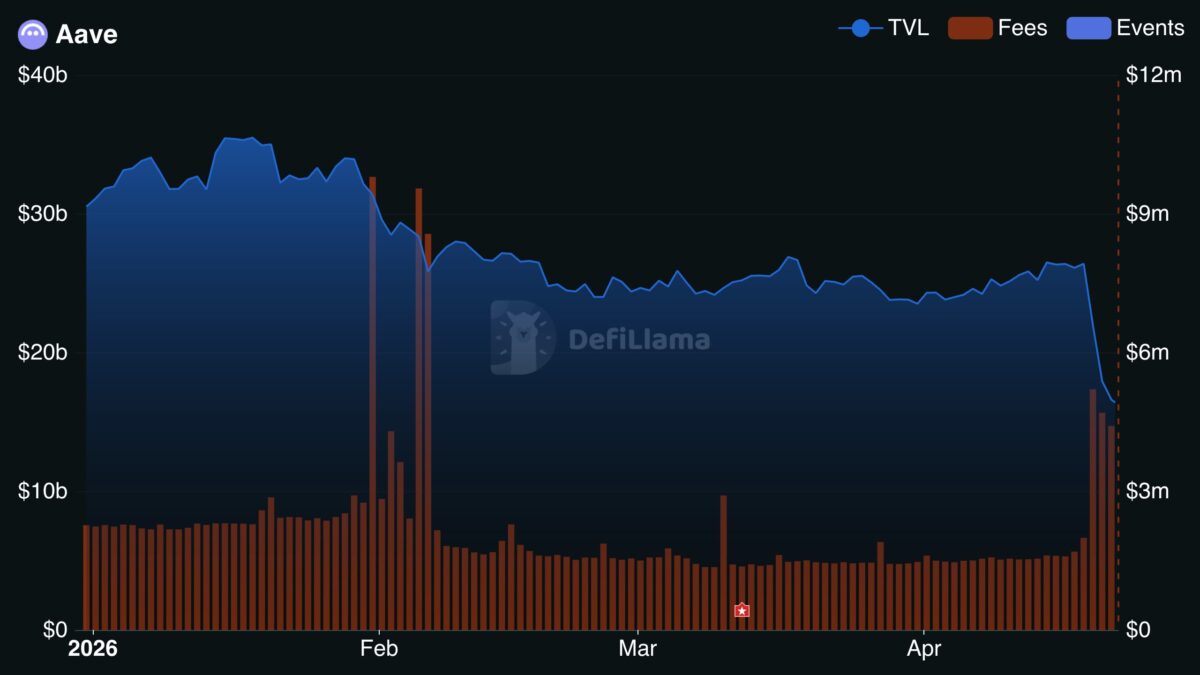
The rsETH collateral abuse turned a bridge exploit into a full-blown lending crisis. Aave, DeFi’s largest lending platform with over $20–26 billion in TVL pre-incident, faced massive bad debt estimates ranging from $124 million to $230 million depending on loss socialization. Utilization rates in core markets (USDT, USDC, WETH) spiked toward 100%, creating withdrawal bottlenecks. Over $6 billion fled Aave alone in the following days, with broader DeFi TVL dropping $7–13 billion in 24–48 hours across top chains. AAVE token price plunged more than 18%.

Aave’s governance and risk teams acted decisively: the Protocol Guardian froze all rsETH and wrsETH reserves across V3 and V4 deployments on Ethereum and multiple L2s, setting loan-to-value (LTV) to zero. This contained the immediate bleed but left suppliers temporarily locked and reignited debates about collateral risk models in an era of composable LRTs.
Also Read: A $292 Million Wake-Up Call: Inside KelpDAO Hack That Exposed DeFi’s Fragility
The Centralization Reckoning: Arbitrum’s Security Council Steps In
As funds flowed across chains, Arbitrum’s Security Council— an elected body with emergency powers—intervened on April 21. Using an atomic upgrade to the inbox contract, they froze 30,766 ETH (approximately $71 million) tied to the exploitor on Arbitrum One and moved it to a governance-controlled wallet (0x…0DA0) pending further DAO approval.
The move was praised by some as responsible stewardship that prevented further laundering, especially against a suspected Lazarus actor. Others decried it as proof that even mature L2s like Arbitrum remain multisig-governed at heart. Justin Sun and others contrasted the swift L2 council action with Tron’s L1 “decentralization,” fueling a broader philosophical debate: when does emergency intervention cross into centralized control?
The Stablecoin Hammer Drops: $344 Million USDT Frozen on Tron (April 23)
The month’s chaos peaked on April 23 when Tether, in coordination with U.S. law enforcement and OFAC, blacklisted and froze $344 million USDT across two Tron wallets—one holding ~$213 million and the other ~$131 million. The addresses were linked to illicit activity and sanctions evasion. It was one of Tether’s largest single enforcement actions and underscored how regulatory pressure intensifies during periods of heightened exploit activity.
A Parallel Warning: The eth.limo DNS Hijack ( April 18)
While the DeFi ecosystem reeled from the rsETH exploit on April 18, another incident underscored the fragility of Web3’s off-chain infrastructure. The popular ENS gateway eth.limo—a free, open-source service that translates Ethereum Name Service (ENS) domains into accessible HTTPS URLs via IPFS and other decentralized storage—suffered a domain hijack.
Attackers used social engineering to impersonate an eth.limo team member and trick the domain registrar EasyDNS into initiating an account recovery process. They gained temporary control, altered nameservers (switching them to Cloudflare and later Namecheap), and could have redirected traffic from wildcard *.eth.limo domains—including high-profile sites like vitalik.eth.limo—to phishing pages or malware.
Ethereum co-founder Vitalik Buterin issued an urgent public warning, advising users to avoid all eth.limo URLs and providing direct IPFS links as safe alternatives. DNSSEC protections ultimately limited the damage by rejecting unsigned malicious responses, and the domain was recovered within hours. No major fund losses were reported, but the incident exposed how centralized DNS dependencies and social-engineering vectors can threaten user access to decentralized websites.
The eth.limo breach, occurring on the same day as the rsETH exploit, served as a stark reminder that DeFi’s front-end and infrastructure layers remain soft targets. It echoed similar past incidents (such as domain hijacks affecting other protocols) and amplified the month’s overarching theme: even non-smart-contract components of the ecosystem are vulnerable to human and operational failures.
Why This Month Was Different: Systemic Lessons from the Cascade
April 2026’s perfect storm revealed three structural weaknesses that no amount of isolated audits can fully mitigate:
- Bridge Fragility and Single Points of Failure: From Hyperbridge’s MMR proof bypass and unlimited minting to LayerZero’s configuration (single DVN verifier) exploit highlights the weak link in crypto security. Cross-chain messaging remains a high-value target, especially for LRTs that promise seamless liquidity.
- Composability Risks with LRTs: Liquid restaking tokens like rsETH were designed for yield maximization, but when unbacked supply floods lending markets, the dominoes fall fast. Aave’s experience shows how quickly “over-collateralized” positions can turn toxic.
- State-Sponsored Professionalization: Lazarus Group’s involvement in both mega-hacks—months of preparation for Drift, sophisticated infrastructure compromise for rsETH—demonstrates how nation-state actors are scaling their operations. Estimates suggest the group has stolen $6–7 billion historically, with April adding hundreds of millions more to North Korea’s coffers.
Protocols That Hit Pause and the Road to Recovery
Beyond the majors, several protocols paused or froze operations: Kelp DAO across chains, SparkLend, Fluid, Upshift, and smaller players caught in the rsETH contagion wave. Aave’s “Umbrella” module and governance proposals for bad-debt handling are now under urgent discussion. Kelp DAO faces pressure to socialize losses or backstop rsETH holders.
Recovery remains uncertain. Funds laundered through mixers or bridges may prove difficult to claw back, especially from Lazarus-linked wallets. Insurance protocols and on-chain coverage may see renewed demand.
Also Read: DeFi United: How Crypto Projects Came Together to Plug a $292M Hole
Forward Outlook: Maturity or Mass Exodus?
Black April forces a reckoning. DeFi builders must prioritize MPC wallets, improved verifier diversity, ZK-based bridging, reduced over-composability, and clearer loss-socialization rules. Regulators will likely point to these events as justification for tighter oversight on bridges and stablecoins.
Yet the bull case persists: crises accelerate maturation. Protocols that survive and transparently recover will rebuild trust. Capital may shift toward more conservative tokenized real-world assets (RWAs), but the core innovation of permissionless finance endures.
For users and protocols alike, the message is clear: assume composability risk, verify governance assumptions, and never underestimate state-level adversaries. April 2026 wasn’t the end of DeFi—it was the loudest warning yet that security, decentralization, and usability must evolve together.
Also Read: Crypto’s $606M April Nightmare: 12 Hacks, 18 Days, Worst Month Since Bybit Heist