
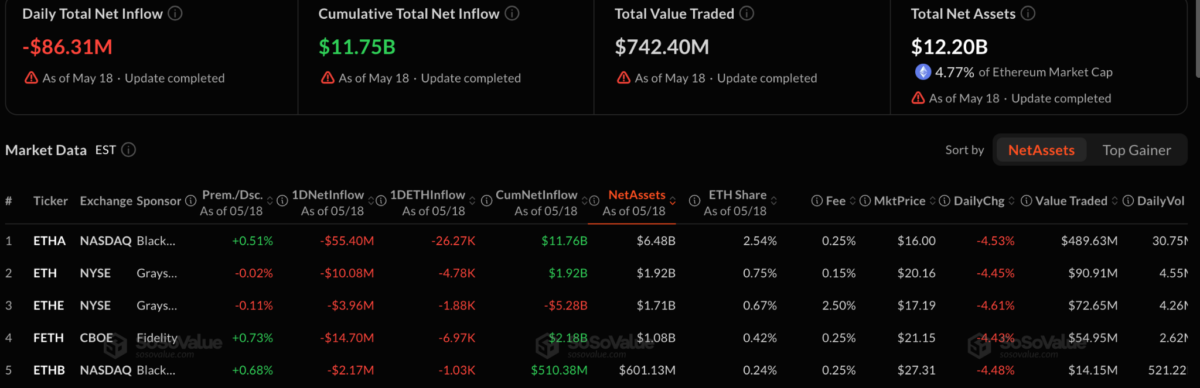
Institutional investors pulled millions from U.S. spot Ethereum ETFs on May 18 as crypto markets extended their latest downturn and Ethereum prices slid toward critical support levels. The funds recorded roughly $86.31 million in net outflows, marking a sixth straight day of withdrawals and signaling rising caution among large investors amid weakening market sentiment.
BlackRock’s ETHA accounted for most of the selling pressure after investors withdrew nearly $55.4 million during the session. Fidelity’s FETH and Grayscale’s ETH product also posted sizable exits. However, trading activity remained active, with Ethereum ETF volumes reaching roughly $742.4 million, suggesting investors continued adjusting positions rather than fully abandoning exposure to the asset class.

Institutional caution pressures Ethereum
The selling pressure stretched far beyond a single trading session. CoinGlass data showed that since May 11, U.S. spot Ethereum ETFs have posted daily outflows as investors reacted to falling crypto prices and growing macroeconomic uncertainty. The sharpest withdrawal came on May 12, when investors pulled nearly 55,840 ETH from the funds, roughly $130.6 million, highlighting rising caution across institutional markets.
A brief recovery attempt appeared on May 14 after Fidelity, VanEck, and Franklin Templeton products attracted modest inflows. However, the rebound quickly lost momentum as fresh withdrawals returned across the sector. As a result, the broader trend suggested investors preferred reducing short-term risk exposure rather than increasing positions during market weakness.
Ethereum price is also still under pressure in the spot market. CoinGecko data shows ETH falling to $2,104, down 9.3% over the past week. The decline erased Ethereum’s April gains and pushed the asset toward its lowest trading level since early April.
Bitcoin ETFs also reflected the broader risk-off mood across crypto markets as institutional investors reduced exposure to digital assets. SoSoValue data showed U.S. spot Bitcoin ETFs recorded roughly $648.6 million in net outflows on May 18, marking one of the sector’s largest daily withdrawals in recent weeks.
BlackRock’s IBIT accounted for most of the selling pressure after investors pulled nearly $448 million from the fund. Fidelity’s FBTC and Bitwise’s BITB also posted sizable outflows, highlighting growing caution among large investors amid weakening crypto prices across the market.
Analysts watch key technical levels
On the technical side, the outlook on Ethereum is getting even worse with growing selling pressures in the cryptocurrency market at large. The momentum signals demonstrate that the buyers’ control is fading amid ETH inability to hold above the $2,300 support. MACD is showing negative territory again, and RSI dropped close to 36.
Traders now closely watch the $2,100 support zone, which has acted as a short-term floor in recent sessions. If Ethereum breaks below that level, sellers may target the psychological $2,000 mark next. Also, there is a deeper support near $1,750, where buyers previously returned during March’s correction.
Still, not every market watcher expects prolonged weakness. Fundstrat analyst Tom Lee described the recent decline as a potential buying opportunity despite the broader market pullback. “We view the recent pullback of ETH to below $2,200 as an attractive opportunity,” Lee explained.
Lee also linked Ethereum’s recent weakness to rising oil prices and broader macroeconomic pressure. “Oil reversing = ETH prices recovering,” Lee said, arguing that energy markets currently influence crypto sentiment more heavily than usual.
Despite the latest withdrawal streak, long-term demand for Ethereum investment products has not fully collapsed. U.S. spot Ethereum ETFs still hold more than $11.75 billion in cumulative inflows since launch. As a result, the recent outflows seem to be a short-term defensive move rather than a complete institutional retreat from crypto markets.
Also Read: Ethereum Foundation Exodus Continues With Two New Departures