
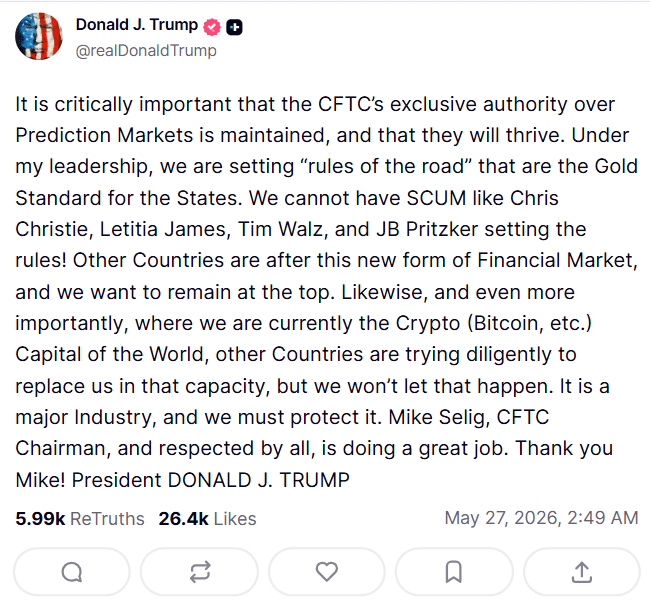

President Donald Trump posted on Truth Social late Tuesday that he considers it “critically important” for the CFTC to maintain exclusive authority over prediction markets, directly inserting himself into the escalating legal battle between federal and state regulators.
“Under my leadership, we are setting ‘rules of the road’ that are the Gold Standard for the States,” Trump wrote. “We cannot have SCUM like Chris Christie, Letitia James, Tim Walz, and JB Pritzker setting the rules!”
Trump also tied the prediction market fight to his broader crypto agenda, writing that “other Countries are trying diligently to replace us” as the “Crypto Capital of the World” and that he would not let that happen. He praised CFTC Chairman Michael Selig as “respected by all” and “doing a great job.”
The post marks the first time Trump has directly and publicly intervened in the prediction market jurisdictional dispute—a fight that has already produced federal lawsuits against at least six states.
The Trump Family’s Financial Ties
Trump’s intervention comes against a backdrop of documented financial connections between his family and the prediction market industry.
Donald Trump Jr. joined Kalshi as a paid strategic advisor in January 2025, then joined Polymarket’s advisory board in August 2025 after his venture firm 1789 Capital made a strategic investment in the platform. The investment was in the “double-digit millions of dollars.” Trump Jr. now holds advisory roles at both of the industry’s dominant platforms simultaneously.
A spokesman for Trump Jr. has said on multiple occasions that he does not bet on prediction markets and has not interacted with government officials on behalf of either company.
Separately, Trump Media & Technology Group (Nasdaq: DJT)—majority-owned by the president and his family—announced in October 2025 that Truth Social would launch Truth Predict, a prediction market product built in exclusive partnership with Crypto.com Derivatives North America (CDNA), a CFTC-registered exchange. Beta testing was announced for “the near future,” with a full US launch to follow. Truth Predict would let Truth Social users trade event contracts on elections, sports, interest rates, and more, converting platform “Truth gems” into Cronos (CRO) tokens.
In other words, the president is publicly championing an industry in which his son holds advisory and investment positions across both leading platforms, and his own company is preparing to enter as a direct competitor.
The Legal Battle Trump Is Weighing In On
Trump’s post did not come from nowhere. The CFTC under Chairman Selig has been waging an increasingly aggressive campaign to assert federal supremacy over prediction markets and preempt state-level regulation.
Since February 2026, the CFTC has withdrawn its 2024 proposal to ban political prediction markets, filed amicus briefs defending Polymarket and Kalshi against state gambling enforcement actions, and launched lawsuits against Arizona, Connecticut, Illinois, New York, Wisconsin, and most recently Minnesota—which became the first state to pass an outright legislative ban on prediction markets under a bill signed by Governor Tim Walz.
Thirty-nine attorneys general from across the political spectrum have sided with Nevada in its battle to enforce state gambling laws against Kalshi. Massachusetts won a preliminary injunction against Kalshi in January 2026, though it is on hold pending appeal.
The individuals Trump named in his post are directly connected to these actions. Former New Jersey Governor Chris Christie has publicly defended states’ authority to regulate gambling products. New York Attorney General Letitia James filed lawsuits alleging prediction markets violate state gambling laws. Minnesota Governor Tim Walz signed the first-of-its-kind state ban. Illinois Governor JB Pritzker’s state is the subject of one of the CFTC’s preemption lawsuits.
Selig, as the sole sitting commissioner on the CFTC’s five-seat board—with four vacancies still unfilled by Trump—has been able to pursue the preemption strategy without internal opposition.
Why This Raises Questions
The overlap between Trump’s policy advocacy and his family’s financial exposure to prediction markets has drawn attention from multiple outlets and from Congress.
A New York Times investigation published this week reported that senior CFTC officials overrode career staff concerns about fraud protections and consumer safeguards on prediction market applications tied to Trump family businesses. CFTC staff who raised concerns about crypto oversight reportedly faced internal investigations or removal.
On the legislative front, Senators Kirsten Gillibrand (D-NY) and Dave McCormick (R-PA) introduced a bill on May 1 that would bar members of Congress, the president, the vice president, and senior executive branch officials from trading event contracts on prediction market platforms. Senator Bernie Moreno has proposed a separate prohibition covering senators specifically.
The “Death Bets Act,” introduced in March by Rep. Mike Levin and Sen. Jeff Merkley, would permanently ban CFTC-registered exchanges from listing contracts tied to war, terrorism, assassination, or death — following $529 million in Iran-related trading volume on Polymarket during the February-March military strikes.
Neither the Trump family’s financial ties nor the legislative proposals have slowed the CFTC’s preemption campaign. Courts have delivered mixed results—federal judges ruled in Kalshi’s favor in New Jersey and Tennessee, while state courts in Nevada and Massachusetts issued injunctions against the platform.
What It Means
Trump’s public endorsement removes any remaining ambiguity about where the executive branch stands. Prediction markets are not just tolerated under this administration — they are actively championed, legally defended at federal expense, and commercially pursued by the president’s own media company.
Whether that constitutes sound industrial policy, a conflict of interest, or both depends on where you sit. What is no longer in question is that the prediction market industry’s regulatory trajectory in the United States is now inseparable from the Trump family’s financial interests in it.