

Bitcoin price has fallen below $62,000 for the first time since early July, extending a brutal November selloff as institutional investors pull billions from the market. BTC touched $61,270 just now, before recovering slightly to trade around $61,700.
Bitcoin price has now lost more than 10% over seven days, with selling pressure spreading across equities, precious metals and other risk assets. Yesterday’s $582.2 million outflow from US spot Bitcoin ETFs added another blow, bringing November withdrawals close to $3.5 billion.
BlackRock’s iShares Bitcoin Trust (IBIT) accounted for $541.1 million of Thursday’s withdrawals, its largest single-day outflow since launching. The same session saw $727 million in crypto liquidations, with bullish traders absorbing most of the damage.
Institutional demand is weakening, leveraged buyers are being forced out, and the Federal Reserve’s increasingly hawkish outlook is making speculative assets less attractive.
Bitcoin is now approaching $60,000, a level that could determine if the correction finds a floor or develops into something uglier.

Bitcoin ETF Exodus and $727M Liquidations Put Bulls on the Defensive
The ETF withdrawals are arguably the biggest concern for Bitcoin holders right now. Spot Bitcoin ETFs became an important source of institutional demand after launching in January 2024. Their buying helped absorb available supply and gave traditional investors a regulated route into the market.
That demand is now moving in the opposite direction. US spot Bitcoin ETFs have lost more than $1.1 billion this week alone. November’s cumulative withdrawals have approached $3.5 billion.
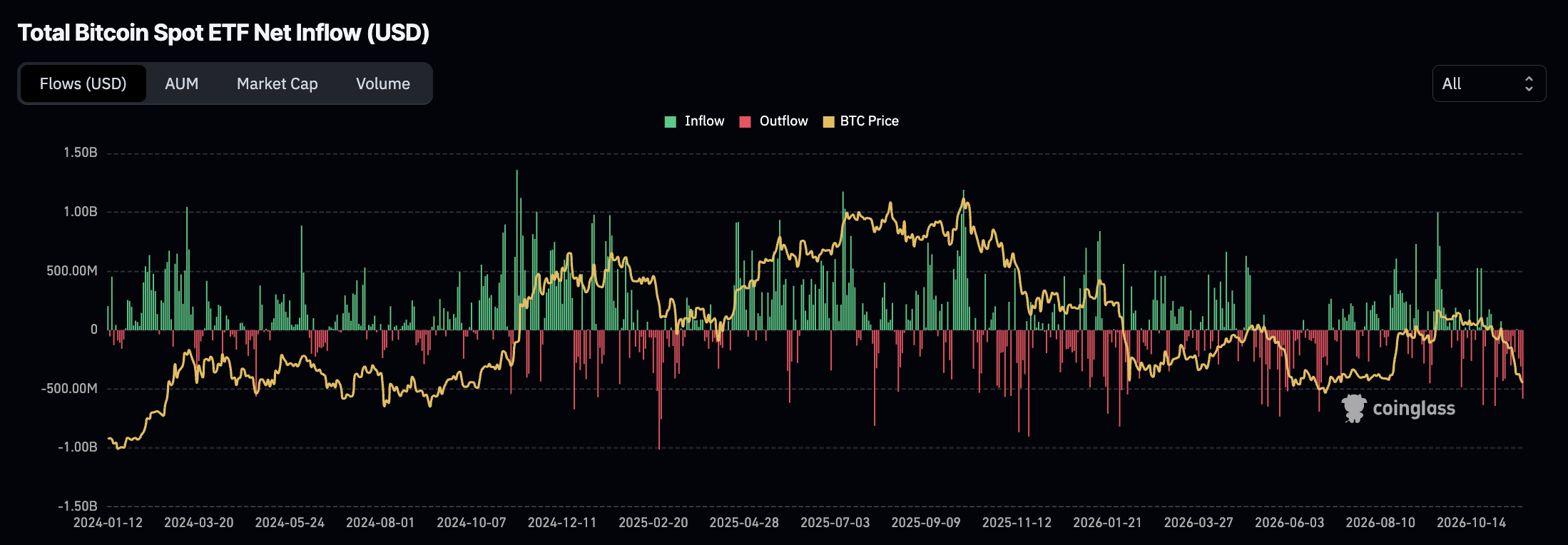
The pressure extends beyond ETFs. Rising Treasury yields and expectations of another Federal Reserve rate increase in December have encouraged investors to reduce exposure to assets that offer no regular income.
Meanwhile, derivatives traders are taking heavy losses. CoinGlass data showed more than $700 million in liquidations across crypto markets over 24 hours. Long positions accounted for 86% of the total.
Bitcoin itself recorded nearly $202 million in liquidations, with bullish traders suffering the majority of forced closures.
This creates a difficult environment for buyers. Falling prices trigger liquidations, which create additional selling pressure and push prices lower. The reduction in open interest also suggests excessive leverage is being flushed from the market.
Discover: The Best Token Presales
Bitcoin Price Prediction: $60K Breakdown or Relief Rally?
The immediate battle is around $60,000. Bitcoin needs to reclaim $62,000 and establish support above it before bulls can confidently argue that the latest breakdown was temporary.
There are three possible scenarios:
Scenario 1: Bitcoin loses $60K and heads toward $58K or $53K.
This is the bearish outcome. A decisive break below $60,000 could trigger another wave of stop-loss orders and leveraged liquidations.
The next downside area sits around $58,000, while more aggressive technical projections point toward $53,700.
The daily chart offers little encouragement for bulls. Bitcoin trades below its major moving averages, while bearish momentum continues to dominate. A sustained recovery in ETF flows would become increasingly important to prevent further deterioration.
Scenario 2: Bitcoin stabilizes between $60K and $62K.
This would give buyers time to absorb available supply without immediately reversing the entire November decline.
The liquidation wave has already removed considerable leverage from the market. If ETF withdrawals begin slowing, Bitcoin could establish a trading range before attempting another recovery.
But sideways trading alone would not confirm a bottom. Buyers need to demonstrate that they can defend support through multiple sessions.
Scenario 3: Bitcoin reclaims $62K and launches a relief rally.
A recovery above $62,000 would provide the first meaningful sign that sellers are losing control. A move toward $65,000 would then become possible, followed by resistance around $68,000.
Consistent ETF inflows, improving market sentiment, and a weaker dollar would strengthen this scenario. Without those developments, any rebound risks becoming another opportunity for sellers to exit.
Should Bitcoin Holders Sell, Hold or Buy the Dip?
For existing holders, the decision depends heavily on their entry price, investment horizon, and exposure. Long-term holders who bought substantially below current prices have more room to withstand volatility. Selling simply because Bitcoin crossed a psychological threshold risks locking in profits or losses without knowing whether the broader investment thesis has changed.
However, investors holding leveraged positions face a different problem. Falling prices can trigger forced liquidations regardless of their long-term convictions. Reducing leverage and protecting available capital should take priority over waiting for a rebound.
For buyers, the temptation to buy the dip is understandable. Bitcoin is considerably cheaper than it was just weeks ago, but cheaper does not automatically mean undervalued.
Buying in stages rather than committing an entire allocation around $61,000 offers more flexibility if the market tests $58,000 or even $53,700.
Bitcoin price remains vulnerable to another leg down. The $60,000 level is no longer just a psychological milestone. It is where the next major battle between buyers and sellers.
Discover: The Crypto Presales This Q4 2026
The post Bitcoin Price Crashes Below $62K: What Should You Do? appeared first on KryptoNews.