
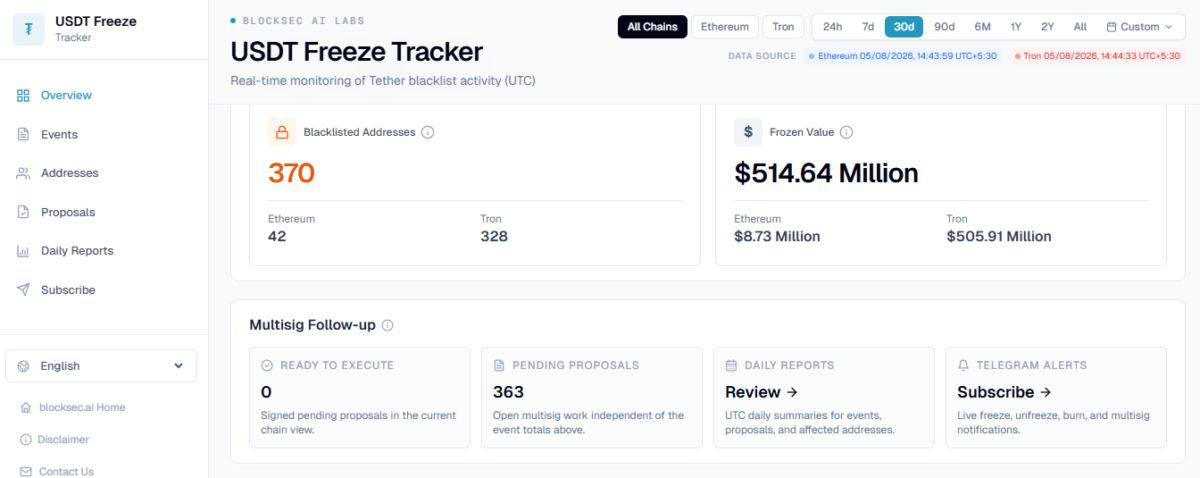
Tether has blacklisted 370 wallet addresses and frozen $514.64 million in USDT over the past 30 days, according to real-time data from BlockSec’s Phalcon Compliance USDT Freeze Tracker, as the stablecoin issuer’s enforcement operations continue to accelerate through 2026.
The data, captured as of May 8, 2026, reveals a stark network-level asymmetry: Tron dominates the enforcement activity with 328 blacklisted addresses and $505.91 million frozen, while Ethereum accounts for just 42 addresses and $8.73 million. The tracker also shows 363 pending multisig proposals awaiting execution, suggesting a significant pipeline of additional freeze actions in process.

Tron: The Enforcement Epicenter
The overwhelming concentration of freeze activity on Tron is consistent with a pattern that has defined Tether’s enforcement posture throughout 2026. The Tron network has become the primary venue for high-volume, low-cost USDT transfers — and, by extension, for the illicit flows that draw regulatory scrutiny.
Of the $514.64 million frozen in the past 30 days, Tron accounts for 98.3% of the value. This aligns with data, which previously found that Tron-based USDT accounted for roughly $1.75 billion of Tether’s cumulative $3.3 billion in frozen assets between 2023 and 2025 — now significantly exceeded as 2026 enforcement actions push the total past $4.2 billion.
The disparity between Tron and Ethereum freeze volumes is partly structural. Tron’s low transaction fees make it the preferred network for rapid, high-frequency stablecoin movement — exactly the characteristics that attract both legitimate remittance users and illicit operators.
A Record-Setting Year for USDT Enforcement
The 30-day freeze total of $514.64 million nearly matches the single largest enforcement action in Tether’s history: the approximately $544 million frozen in February 2026 in connection with a Turkish illegal gambling empire, coordinated with Istanbul prosecutors.
The cadence of major freeze events in 2026 alone underscores the acceleration. In January, Tether froze $182 million across five Tron wallets in a single coordinated action. In April, the largest single action of the year saw $344 million frozen across two Tron addresses later linked by U.S. officials to Iran’s Central Bank and sanctions evasion operations. That freeze was coordinated with OFAC and multiple U.S. law enforcement agencies. Most recently, on May 4, Tether froze $38.4 million across 19 Tron addresses tied to the $150 million DSJ/BG Wealth Ponzi collapse, following a cross-chain tracing effort led by on-chain investigator ZachXBT in coordination with Tether, Binance, OKX, and U.S. law enforcement.
How Tether’s Blacklisting Works
When Tether blacklists an address, it invokes the addBlackList function in the USDT smart contract on the relevant chain. Once an address is added, any attempt to send or receive USDT from that wallet is automatically reverted at the block level. The frozen USDT remains visible on-chain but cannot be transferred or redeemed.
In cases involving formal law enforcement seizures, Tether employs a “burn and reissue” mechanism: the frozen tokens are destroyed, and an equivalent amount is minted to a wallet controlled by the relevant law enforcement agency—effectively transferring the assets to government custody without them ever passing through an exchange.
Tether says it currently works with more than 340 law enforcement agencies across 65 countries. CEO Paolo Ardoino has consistently framed the freeze capability as a feature rather than a bug, arguing that USDT creates a safer financial environment than fiat because every transaction is traceable.
The Centralization Debate Persists
Critics continue to point out that Tether’s freeze capability fundamentally contradicts cryptocurrency’s censorship-resistance ethos. Unlike Bitcoin, where no single entity holds freeze privileges, USDT remains under centralized control. Users who hold USDT effectively agree — via Tether’s terms of service — that their tokens can be frozen or confiscated at Tether’s discretion or upon law enforcement request.
The debate is not merely philosophical. A May 2025 report by AMLBot found that a delay in Tether’s two-step blacklisting process—where a public “warning” precedes the actual freeze—allowed over $78 million in USDT to be moved by bad actors before wallets were fully frozen. Tether responded by calling the characterization misleading but did not dispute the underlying mechanics.
Meanwhile, the scale of illicit stablecoin activity continues to grow. Chainalysis estimated that stablecoins would account for 84% of all illicit crypto transaction volume by the end of 2025, with suspicious addresses receiving at least $154 billion—a 162% year-over-year increase. Against that backdrop, the 370 addresses and $514.64 million frozen in a single 30-day window represent both the scale of the problem and the limits of the current enforcement toolkit.
USDT’s market capitalization currently exceeds $151 billion, accounting for roughly 60% of the global stablecoin market.
Also Read: U.S. Says $344M Tether Freeze Was Linked to Iran Sanctions Probe