

The U.S. Bureau of Labor Statistics delivered a sobering update on wholesale costs Wednesday, reporting that the Producer Price Index (PPI) for final demand jumped 1.4 % in April from the prior month—its biggest monthly leap since March 2022.
That pushed the year-over-year rate to 6.0%, the highest reading since December 2022 and well above the 4.9% consensus forecast. Core PPI—which strips out food, energy and trade services—climbed even faster to 1.0% month-over-month and 5.2% annually, both beating expectations.
The rebound from March’s modest 0.5% gain was broad-based. Final demand goods surged 2.0%, services rose 1.2%, and energy prices spiked 7.8%, with gasoline alone up 15.6%. Truck freight and warehousing costs also accelerated sharply.
Upstream pressures were even more striking: processed goods for intermediate demand rose 2.7%, unprocessed goods 4.1%, and intermediate services posted their largest monthly increase since March 2022.
Economists watching the pipeline say these figures point to cost pressures building deep in the supply chain—pressures that often show up in store shelves months later.
Global tensions played a central role. Ongoing disruptions in the Middle East, including flare-ups around the Strait of Hormuz, have kept energy markets on edge and driven commodity prices higher. Supply-chain snarls that never fully healed after the pandemic added fuel. In result, producers are paying more for everything from raw materials to transportation, and many are passing those costs along rather than absorbing them.
Consumer Inflation Reaccelerates, Fueled by Energy
Just a day earlier, the same agency released April’s Consumer Price Index, and the picture was hardly brighter. The CPI for all urban consumers rose 0.6% for the month after a 0.9% March increase, lifting the annual rate to 3.8%—its highest mark since May 2023 and above the 3.7% forecast.
Core CPI, excluding the volatile food and energy categories, still advanced 0.4% monthly and 2.8% yearly, both topping expectations. Shelter costs remained sticky, food prices edged higher, and a range of services showed no sign of cooling.
Real average hourly earnings actually slipped 0.3% over the year, meaning wage gains failed to keep pace with price increases for many households.
Taken together, the twin reports paint a clear picture, which suggests that inflation is not only refusing to fade but is picking up momentum at both the wholesale and retail levels.
The data come as businesses grapple with higher input costs while consumers, already stretched by higher rents and grocery bills, show signs of pulling back on discretionary spending.
Fed’s Path Narrows as Markets and Bitcoin Absorb the Blow
The hotter-than-expected prints leave the Federal Reserve in a tighter spot. Policymakers had been signaling possible rate cuts later this year as inflation cooled through early 2026. Markets had priced in two or even three reductions by December.
Those bets are now in serious doubt. Bond yields climbed immediately after the releases, the dollar strengthened, and equity indexes posted mixed results—some sectors like energy and financials held up, while growth stocks felt the pinch.
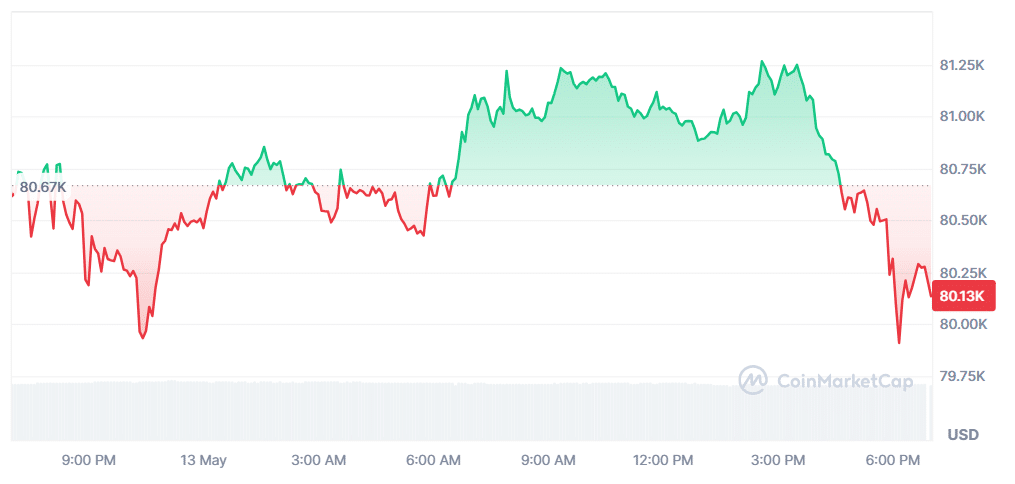
For Bitcoin, the reaction was nuanced. Often labeled “digital gold” for its perceived role as an inflation hedge, the cryptocurrency was already trading in the $80,000–$81,000 range ahead of the data. It has shown resilience through recent macro volatility, recovering quickly from earlier geopolitical sell-offs tied to Iran-related oil shocks.
As the data became published, BTC loss the daily edged and fell to $79,900—trading at $80,134 at the time of publishing.

Traders are now focused on the $78,000 support zone. A break below could open the door to $74,000 or lower if risk sentiment sours further.
On the upside, renewed safe-haven buying could push Bitcoin toward $85,000 if investors view it as protection against sticky prices and delayed easing.
What sets this cycle apart is Bitcoin’s evolution into a macro asset. No longer moving in isolation, it responds to the same signals driving Treasuries and the dollar. The April figures underscore that reality.
Persistent producer-cost pressures could delay the very liquidity boost many crypto bulls had counted on. At the same time, the data highlight longer-term forces—geopolitical risk, energy volatility, supply-chain fragility—that have historically favored hard assets like Bitcoin over the long haul.
Also read: Vietnam Targets Q3 2026 Launch for First Regulated Crypto Asset Market