
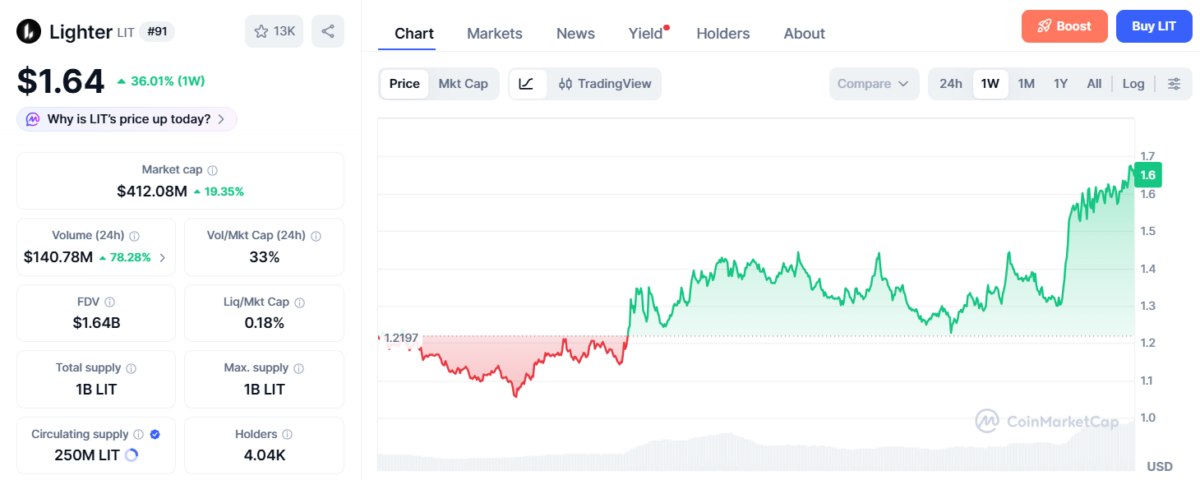
Lighter, the zero-knowledge (ZK) rollup-based perpetual futures decentralized exchange (DEX) on Ethereum, is capturing significant attention in the DeFi space. Its native token, $LIT, has surged more than 20% in the last 24 hours, trading around $1.66 as of June 3, 2026.
This rally coincides with the platform’s June 1 announcement of new real-world asset (RWA) perpetual futures for traditional stocks like Dell ($DELL) and IBM ($IBM), available with up to 10x leverage.
The move underscores Lighter’s strategy to bridge traditional finance with crypto-native trading mechanics. Traders can now access leveraged exposure to equities driven by AI server demand (Dell) and cloud computing with dividend appeal (IBM), all within a fully on-chain, verifiable environment.
Token Performance and Market Dynamics
$LIT, which powers governance, staking, fee sharing, and ecosystem incentives, has seen its market capitalization climb to $412 million with a circulating supply of 250 million tokens. The protocol’s fully diluted valuation (FDV) stands near $1.67 billion.
Trading volume for the token has also seen a robust rise of nearly 80%, exceeding $140 million in 24 hours, reflecting heightened interest and liquidity.

This surge follows a series of positive developments for the protocol. Lighter has consistently ranked among the top perpetual DEXs by trading volume, often competing Hyperliquid—the current leader in the competitive perpetual DEX landscape.
The token’s utility in ecosystem services further ties its value to actual adoption rather than pure speculation. Broader market sentiment in perps trading, which now commands a significant share of global derivatives volume, has also provided tailwinds.
Lighter as Hyperliquid Beta: Traders Eye Similar Upside Potential
As Hyperliquid’s native token $HYPE continued to print fresh all-time highs since last week, market participants are increasingly viewing Lighter as a high-conviction “beta play” in the perp DEX sector.
Hyperliquid has dominated on-chain perpetuals with record volumes exceeding $10 billion daily at peaks, aggressive token buybacks, and deep liquidity, propelling $HYPE well beyond previous records and into top-10 market cap territory. This success has validated the narrative that specialized, high-performance perp platforms can capture outsized value in DeFi derivatives.
Traders now see parallel dynamics unfolding at Lighter. With comparable architecture advantages—including verifiable ZK matching and aggressive RWA expansions—$LIT is perceived as an earlier-stage counterpart that could mirror Hyperliquid’s trajectory.
Community discussions frequently label Lighter the “next Hyperliquid,” citing its rapid volume gains, zero-fee model for retail, and Ethereum L2 positioning. As $HYPE consolidates at highs, capital is rotating into perceived undervalued challengers like Lighter, where RWA perps and ecosystem growth offer fresh catalysts.
This beta narrative is amplified by direct comparisons in trading volume, open interest battles, and token utility models. While Hyperliquid leads in absolute scale, Lighter’s innovations in cost efficiency and asset variety position it for accelerated catch-up growth.
Analysts and on-chain observers note that successful perp DEX leaders tend to reward early momentum with sustained token appreciation, driving the current sentiment that $LIT has considerable room to run if it continues stealing market share.
RWA Perps and the Future of Hybrid Finance
The recent addition of $DELL and $IBM perpetual futures represents Lighter’s continued expansion into real-world asset (RWA) derivatives. The platform now offers up to 10x leveraged trading on these traditional equities, providing crypto users with on-chain exposure to established companies without relying on conventional intermediaries.
Lighter operates as a custom ZK-rollup on Ethereum, featuring on-chain verifiable order matching and liquidations. Its design includes low-latency execution and zero retail trading fees. These technical attributes have contributed to its positioning among active perpetual DEXs in 2026.
In the broader competitive landscape, often referred to as the “perp DEX wars,” platforms are competing on execution speed, security features, and available assets.
Lighter’s Ethereum L2 foundation and RWA listings reflect ongoing efforts to connect traditional finance with decentralized trading infrastructure. Whether this leads to meaningful adoption from institutional or retail participants will depend on regulatory developments, overall market conditions, and sustained platform performance.
Also read: How Hyperliquid’s Revenue-Backed HYPE Is Creating Self-Funding Corporate Balance Sheets