
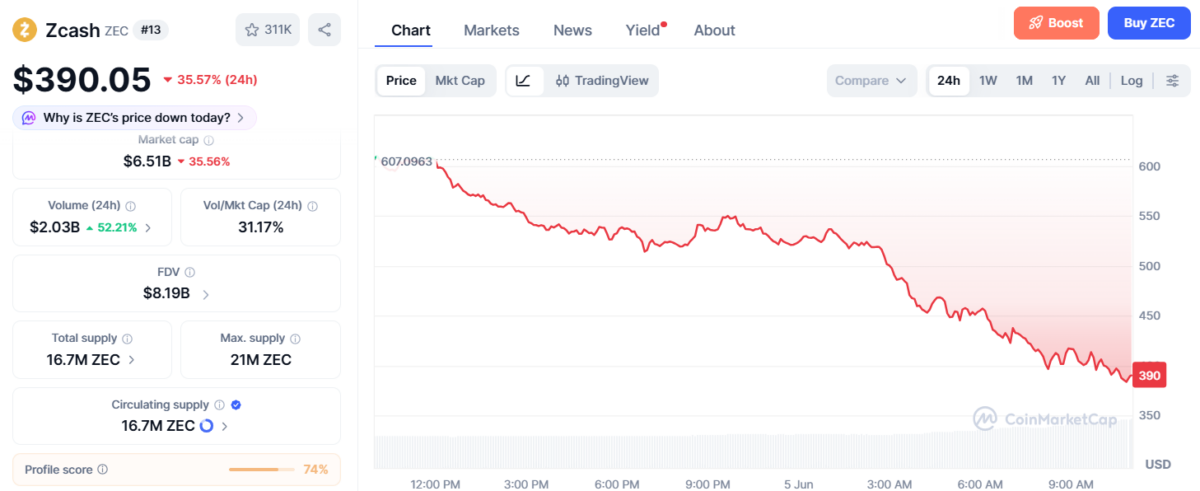

Zcash (ZEC), a prominent privacy-focused cryptocurrency, has suffered a sharp decline following the disclosure of a critical vulnerability in its Orchard shielded pool.
Security researcher Taylor Hornby discovered the flaw on May 29, 2026, during a protocol audit. The issue involved weaknesses in zero-knowledge proof circuits that could have allowed the creation of unlimited undetectable counterfeit ZEC.
As of June 5, 2026, ZEC’s price has plummeted approximately 36%, reflecting market unease over the incident amid broader cryptocurrency volatility. The rapid response from developers helped stabilize operations, but investor confidence took a hit.
Discovery of the Vulnerability
On May 29, 2026, security researcher Taylor Hornby identified the flaw during a routine protocol audit. The issue stemmed from weaknesses in the zero-knowledge proof circuits, potentially allowing attackers to create unlimited undetectable counterfeit ZEC tokens.
This discovery sent shockwaves through the crypto community, highlighting the complexities of maintaining robust privacy features in blockchain systems. Zcash’s emphasis on shielded transactions, which obscure sender, receiver, and amount details, has long been a selling point but also introduced verification difficulties.
“The vulnerability could have been exploited to undetectably create an unlimited amount of counterfeit ZEC within Orchard,” said Zooko Wilcox-O’Hearn, Zcash founder. “Because of the privacy properties of Orchard, there is no way to cryptographically prove whether the vulnerability was exploited before it was remediated. However, a network upgrade can be deployed to protect users and prove the integrity of the Zcash supply.”
Present since the Orchard pool’s activation around 2022, the vulnerability raised concerns about possible past exploitation, even though the Zcash team confirmed no evidence of actual attacks.
Hornby privately disclosed the issue to Zcash Open Development Lab (ZODL) core engineers on the same day of discovery. This responsible disclosure allowed the team to act swiftly, preventing potential exploitation.
Experts noted that while the vulnerability was severe in theory, practical exploitation would have required sophisticated knowledge and resources. Nevertheless, the four-year dormancy period fueled speculation about undetected risks in privacy-centric protocols.
Emergency Response and Network Upgrades
Zcash developers acted decisively. On June 2, an emergency soft fork via Zebra 4.5.3 temporarily disabled Orchard actions at a specific block height, halting shielded transactions in the vulnerable pool while keeping transparent operations live. This was followed by the NU6.2 hard fork on June 3 at block 3,364,600, which patched the proof circuits and restored functionality through Zebra 5.0.0.
Exchanges briefly paused ZEC deposits and withdrawals to manage the transition smoothly. The Zcash Foundation emphasized that the overall 21 million ZEC supply cap remained secure, with no user funds lost. Block production continued normally, demonstrating network resilience despite the complexity of the upgrade.
The rapid fix, completed in days, highlighted Zcash’s proactive security stance. However, the temporary freeze of a significant portion of private transactions—reportedly over 85% of shielded activity—drew criticism. Monero supporters pointed out that its design would not allow such selective disabling, reinforcing perceptions of Monero as a steadier privacy option amid the turmoil.
Proposals for future upgrades include enhanced verifiable supply accounting to address lingering trust issues without compromising core privacy. These steps aim to differentiate Zcash through compliance-friendly selective disclosure features, which Monero largely avoids in favor of uniform anonymity.
Market Impact and Monero’s Rise as Competitor
The vulnerability news triggered heavy selling, amplifying ZEC’s 36% decline amid broader market conditions. Trading volume surged as investors reassessed privacy coin risks. While Zcash showed some stabilization post-fork, sentiment remains cautious, with analysts watching key support levels.
Monero has trended positively in discussions and price action, benefiting from the narrative shift. XMR’s mandatory privacy and community-driven development contrast with Zcash’s optional model and history of upgrades.
Comparisons emphasize Monero’s resistance to selective freezing and potentially smaller risk of similar circuit bugs due to its uniform transaction pool.
“Zcash ZKP architecture is over-engineered while Monero’s ring approach was much simpler and easier to have faith in,” said a user on X.
Privacy coins as a sector face regulatory pressures, but this event has spotlighted technical differences. Users on X claim that while Zcash offers institutional appeal through viewing keys and flexibility, Monero prioritizes uncompromised anonymity, appealing to users wary of optional features. Market data shows Monero holding steadier during the ZEC turmoil, with some capital rotation speculated.
“If the privacy narrative is supposedly so strong, why is no one using it? Other than a couple edge cases ZEC has less than 10K transactions per day. Monero has 3x that,” said The White Whale, a popular crypto trader.
Long-term, Zcash’s recovery depends on rebuilding confidence through transparent audits and successful upgrades. Its recent institutional interest, including Grayscale trust growth, provides a foundation, but the incident serves as a reminder of ongoing risks. Monero, with its consistent privacy default, may continue gaining as the “safer” privacy play in uncertain times.
The Zcash episode illustrates the delicate balance in privacy cryptocurrency design: advanced features versus verifiable security. As the market digests the 36% drop, Monero’s trending status highlights shifting preferences toward default privacy models.
Also read: SIREN Pumps 22% to $0.719 as Market Dumps, But Is It Sustainable?