
Key Highlights
- IOG is stepping away from Cardano node development as engineering control moves to independent teams and the wider community.
- The Van Rossem hard fork was approved on July 13 and is scheduled to activate on July 18, preparing Cardano for lower execution costs and future Leios scaling.
- ADA surge 2.3% as trading volume increased 41.2% to around $350 million.
Input Output Global (IOG) is stepping away from Cardano node development as the blockchain moves into the final stage of its plan to decentralize engineering. The move will see IO Labs hand Haskell node development to community control, while independent teams take on a bigger role in maintaining Cardano’s core software.
The transition is part of a process that IOG said began in 2024 and is expected to be completed by 2027. Under the plan, several independent firms will maintain at least three Cardano implementations written in Haskell, Rust, and Go. Formal specifications will be supervised by community organizations such as Intersect and Pragma, while the wider Cardano community will be able to review and vote on them.
“Protocol and governance were already decentralized. Now engineering is too,” IOG said in X post.
In simple terms, Cardano aims to ensure that one company does not control the development of the software that keeps the blockchain running. Instead, different independent teams will be able to work on different versions of the Cardano node.
The move marks the final stage of Voltaire
IOG said the process is the final stage of the Voltaire era, which is focused on giving the Cardano community more control over the network. The company said the move will create a system where different firms can maintain separate implementations, while formal rules and specifications help ensure that the network continues to work properly.
Charles Hoskinson, the founder of Cardano, said IO Labs is now spinning out the Haskell Node to community curation and control. He added that the ecosystem now has several independent options for continuing the development of the network.
Van Rossem upgrade gets community approval
The transition comes as Cardano prepares for the Van Rossem hard fork. The upgrade received governance approval on July 13 after being ratified by Stake Pool Operators (SPOs) and Delegated Representatives (DReps).
Van Rossem is scheduled to go live on July 18 at 21:44:51 UTC at Slot 192,844,800. Intersect has asked infrastructure providers to update their software before the network reaches the hard fork point.
The upgrade prepares Cardano for future scaling
The upgrade is expected to lower execution costs, which could make transactions and decentralized application operations cheaper on Cardano. It also prepares the technical foundation for Leios, a future scaling upgrade designed to significantly increase Cardano’s transaction capacity before the end of 2026.
The importance of Van Rossem goes beyond the upgrade itself. Its approval shows how Cardano’s governance system is increasingly being used to make major network decisions through community participation.
This is different from Cardano’s earlier development stages, when a smaller number of organizations had greater control over important technical decisions. The latest changes are designed to spread that responsibility across independent developers, firms, community groups, SPOs, and DReps.
ADA price rises as Cardano enters a new phase
At the time of writing, ADA, Cardano’s native token, is trading around $0.1658, up 2.3% today from an intraday low of $0.1579.
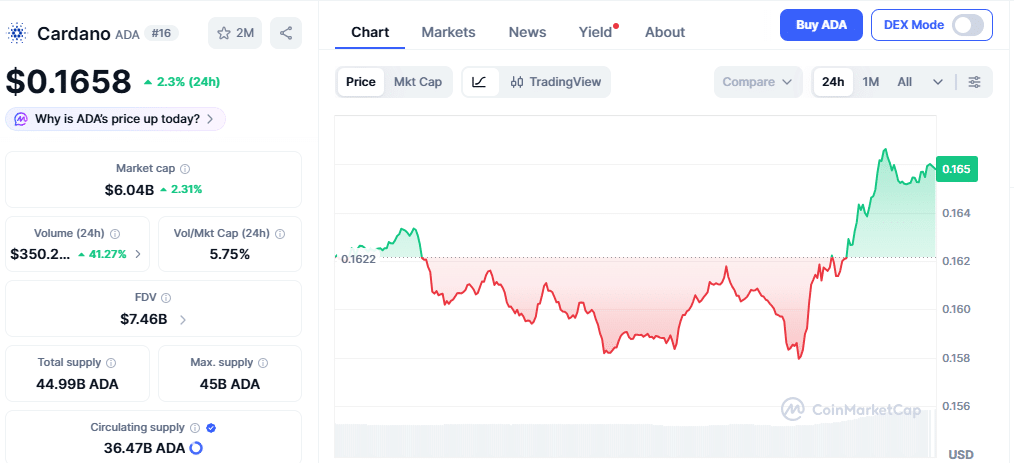
The price increase was accompanied by a 41.2% jump in trading activity over the past 24 hours, with trading volume reaching around $350 million.
Hoskinson described the current stage as part of the network’s growing pains as it moves toward a more distributed development model. Cardano is now entering a period where its engineering, like its protocol and governance, is expected to become more distributed.
Also Read: Ondo Price Rallies 16% After Landmark Integration with DTCC