


Show
Hyperliquid’s native HYPE token gained over 5% on Friday, November 13, after the platform released its third-quarter 2026 report.
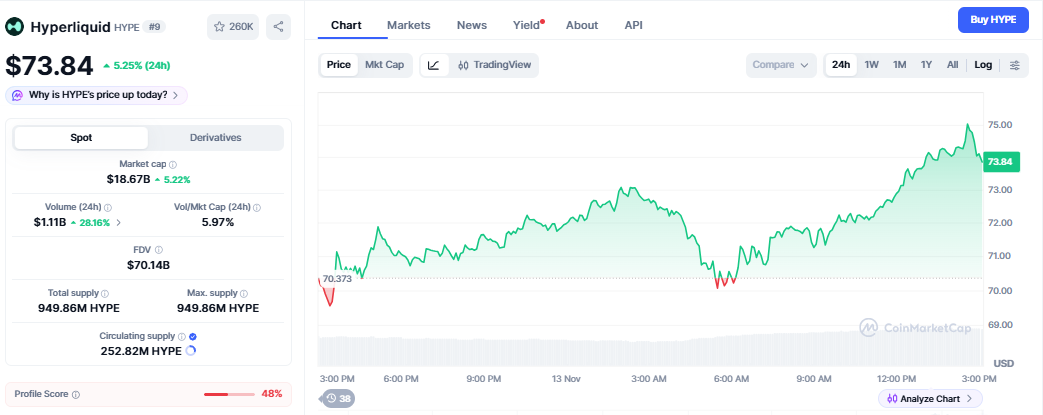
The rally came as the exchange reported $190.9 million in protocol revenue, a 21.7% increase from the previous quarter, according to the Hyperliquid Research Collective (HRC). Shortly after the release, the token surged up by 5.25%, reaching $75 before pulling back. At the time of reporting, the token is trading for $73.84, after pushing from an intraday low below $70, according to CoinMarketCap (as of 15:06 UTC on November 13).
This pushed the market cap up by 5.22% to approximately $18.67 billion in value with its trading activity reaching around $1.11 billion in just 24 hours, up 28.16%.
The HRC report showed that Hyperliquid’s revenue growth came from both trading activity and income earned from USDC reserves. However, despite the quarterly increase, revenue remained 36.5% below the level recorded in Q3 2025.
USDC reserve income adds $17.3 million to revenue
In the Q3 report, Hyperliquid said it generated $173.6 million from trading and network activities during the quarter, representing a 10.7% increase from Q2. Another $17.3 million came from USDC reserve income, which the platform began receiving on August 27.
This additional income accounted for nearly half of the increase in quarterly revenue. It also helped Hyperliquid earn more without depending entirely on fees collected from traders.
Hyperliquid records more traders and trading activity
Beyond revenue, Hyperliquid recorded an average of 65,161 daily active traders during Q3, its highest quarterly figure. This represented a 20% increase from the previous quarter.
Priority fees also reached $9.6 million, approximately 3.3 times the Q2 figure. These are payments traders make to give their orders higher priority. Meanwhile, third-party applications earned $25 million through builder-code fees, representing a 50% increase.
Trading activity also expanded into equity perpetuals. These contracts allow users to trade based on the price movements of stocks without owning the actual shares.
Equity perpetuals recorded $153.8 billion in trading volume, up 161% from Q2. They accounted for 58.8% of HIP-3’s total quarterly volume of $262 billion, with Korean stocks helping drive the increase.
However, the expansion also exposed risks in how these markets handle prices outside local trading hours. A July reference-price incident involving SK hynix perpetuals triggered $57.4 million in liquidations. Trading activity was also concentrated, with trade[XYZ] handling 97.5% of HIP-3 volume in September.
Assistance Fund spends nearly $149 million on HYPE
Hyperliquid’s Assistance Fund spent approximately $148.7 million buying HYPE tokens during Q3, 5.7% more than it spent in the previous quarter.
Despite the higher spending, the fund purchased 26.4% fewer tokens because its average purchase price increased to $72.93. The report also noted that the fund received its first payment in early October, making the money available for Q4 buybacks.
The HRC report raised a question about whether some of the money used for token purchases could have been spent on attracting more traders and developers to the platform.
Hyperliquid moves closer to possible US expansion
Hyperliquid also made progress toward a possible entry into the US market. On August 19, President Donald Trump said the Commodity Futures Trading Commission (CFTC) was working to bring the platform to the country.
Less than a month later, on September 16, Payward, the parent company of Kraken, proposed using Bitnomial, a US-regulated derivatives exchange, to operate a HIP-3 trading venue on Hyperliquid.
The proposal was still awaiting regulatory approval at the end of Q3. As a result, US customers could not yet trade through the planned venue.
Other crypto firms report Q3 earnings
Other companies in the crypto industry also released their third-quarter results. Tether, the issuer of USDT, reported $1.5 billion in net operating profit for Q3, while its reserve buffer increased from $4.1 billion in June to $7.95 billion in September.
Circle, the company behind the USDC stablecoin, reported $865 million in total revenue and reserve income during Q3 2026, up 17% from the previous year. Its average USDC in circulation reached $73.3 billion, an 8% increase, while the value of USDC transactions across blockchain networks rose 49% to $13.9 trillion.
Circle also recorded $226 million in net income from continuing operations and $317 million in adjusted EBITDA, which measures earnings before interest, taxes, depreciation and amortization.
Coinbase also returned to quarterly profitability, recording $718.7 million in net income. However, $715 million came from unrealized gains on crypto assets held for investment, while its adjusted net income stood at $77.7 million.
Bitcoin treasury company Strive reported $509 million in net income, supported mainly by $533.7 million in unrealized gains on its Bitcoin holdings.
Meanwhile, AI cloud provider CoreWeave recorded $3.66 billion in Q3 revenue, representing a 168% increase from the previous year. Its results showed continued revenue growth in the AI infrastructure business during the same earnings period.
Also Read: MANTRA Halts Unbonding for 7 Days Amid Keplr Key Breach; Token Falls 7.3%