

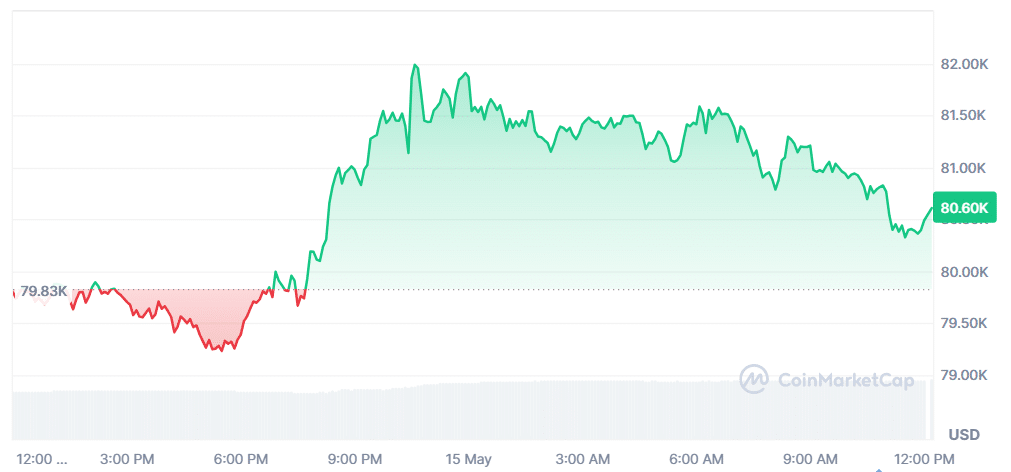
Bitcoin climbed sharply in the past 24 hours, briefly topping $82,000 after the U.S. Senate Banking Committee advanced the landmark CLARITY Act in a bipartisan vote, fueling fresh regulatory optimism across the market.
As per CoinMarketCap data, the cryptocurrency market posted solid gains over the past 24 hours, with regulatory tailwinds overshadowing lingering macro concerns.
The total crypto market capitalization rose toward the $2.7 trillion level, supported by strong institutional signals and key regulatory developments. Trading volumes remained elevated as traders positioned for further clarity on U.S. digital asset rules.
Market Overview
Bitcoin (BTC) surged above $82,000 intraday on the back of the CLARITY Act progress before consolidating in the $80,000–$81,000 range. The move reflected renewed confidence in U.S. policy direction despite ongoing global macro crosscurrents.

Ethereum (ETH) traded near $2,250–$2,300, showing modest gains but slightly lagging BTC in the short term. Altcoins delivered outsized moves, with XRP and DOGE each climbing around 5% amid the broader sentiment lift.
Overall market sentiment turned cautiously bullish, with liquidations skewed toward shorts as regulatory developments provided a clear positive catalyst.
Key Highlights of the Day
Followings are the key news and developments happened in the past 24 hours (as of 11:30 AM IST – May 15, 2026):
Deep Dive: The CLARITY Act Advances in Senate Banking Committee
The standout event in the past 24 hours was the advancement of the Digital Asset Market Clarity Act (CLARITY Act). On May 14, the U.S. Senate Banking Committee approved the bill in a 15-9 bipartisan vote during a markup session. This marked a significant milestone for the 309-page legislation, which aims to establish a comprehensive regulatory framework for digital assets in the United States.
The CLARITY Act seeks to resolve years of regulatory uncertainty by clearly dividing oversight responsibilities: the Commodity Futures Trading Commission (CFTC) would primarily handle digital commodities, while the Securities and Exchange Commission (SEC) would focus on securities aspects. Key provisions include protections for DeFi developers, rules for stablecoins, and mechanisms to classify assets like Bitcoin as digital commodities on a more permanent basis.
The bill also addresses ancillary assets, disclosure requirements, and limitations on insider resales. It includes special disposition restrictions for related persons and provisions aimed at safeguarding consumers while fostering innovation.
During the markup, over 100 amendments were proposed, reflecting intense negotiations. Topics ranged from stablecoin yield restrictions (pushed by banking interests) to concerns over central bank digital currencies and Fed master accounts for crypto entities. Despite partisan sniping, the committee achieved bipartisan support, with two Democrats joining Republicans in the favorable vote.
Industry leaders reacted positively. Coinbase CEO Brian Armstrong described the progress as transformative for U.S. crypto policy, while Ripple’s Brad Garlinghouse emphasized the importance for the millions of Americans already holding digital assets. Chairman Tim Scott highlighted the bill’s potential to deliver certainty and consumer safeguards.
However, the legislation still faces hurdles: it must pass a full Senate vote (requiring 60 votes to overcome potential filibusters), undergo House reconciliation, and navigate further lobbying from banks and other stakeholders.
If enacted, analysts believe the CLARITY Act could accelerate institutional adoption by providing the legal predictability needed for traditional finance to engage more deeply with crypto.
It builds on last year’s stablecoin legislation (the Genius Act) and represents one of the most consequential pieces of crypto regulation in U.S. history. Market participants will now watch closely for the bill’s trajectory in the full Senate and any amendments that could alter its scope.
ETF & Institutional Flows
Institutional momentum remained strong. 21Shares launched the 21Shares Active Crypto ETF (TKNS), the first actively managed U.S. crypto ETF. The fund, with a gross expense ratio of 1.05%, began trading and offers professional management across a basket of digital assets, expanding options beyond passive products.
U.S. spot crypto ETFs showed mixed but recovering flows on May 14. Bitcoin ETFs recorded approximately $131 million in net inflows, with BlackRock’s IBIT leading at around $144 million. Meanwhile Ethereum ETFs posted modest outflows of $5.65 million.
Solana ETFs and XRP ETFs continued to attract steady capital rotation, gaining $6.51 million and $18.52 million respectively, adding to the broadening institutional interest beyond Bitcoin amid regulatory optimism.
DeFi & Token-Specific Developments
DeFi platforms delivered notable updates. Hyperliquid announced it is phasing out its native stablecoin USDH (launched roughly seven months ago) and fully transitioning to USDC. Coinbase will serve as the official USDC treasury deployer and Aligned Quote Asset (AQA) manager under an upgraded framework. As part of the deal, Coinbase gains rights to acquire USDH brand assets, while USDH remains redeemable during a migration period.
The shift is expected to unlock around $5 billion in USDC liquidity, enhance capital efficiency, and unify trading on the platform. Hyperliquid’s HYPE token surged approximately 17% on the news.
In recovery news, Kelp DAO activated rsETH withdrawals, bridging, and EigenLayer claims after completing the first tranche of refills following its April exploit. Aave unpaused rsETH markets across Ethereum Core, Arbitrum, Base, Linea, and Mantle. The protocols have been gradually replenishing the roughly 117,132 rsETH affected in the ~$292 million incident through coordinated efforts involving recovery guardians and safety reserves.
Outlook
The past 24 hours were defined by concrete U.S. regulatory progress through the CLARITY Act, accelerating DeFi innovation, and robust institutional product launches. These factors created a constructive backdrop despite short-term sensitivities to macro data and global events.
The coming days will focus on the full Senate path for the CLARITY Act, ongoing ETF flow trends, and further DeFi platform recoveries. While optimism prevails, crypto markets remain volatile and can shift rapidly on new information.
Also read: Hyperliquid Surges 21% as HYPE ETF Debuts on Nasdaq and Coinbase Deepens Ties