


Show
Circle Internet Group (NYSE: CRCL) shares fell 7.2% on Monday after Mizuho lowered its price target on the stablecoin issuer, warning that AI-powered financial assistants could direct users away from USDC and toward higher-yielding, deposit-insured bank accounts.
Circle’s stock traded at $79.72 on October 26, down $6.19 from Friday’s close of $85.91. The shares opened at $82.36 and moved between $78.81 and $82.80 during the session. Trading volume reached about 8 million shares, below the reported average of 13.06 million, according to data from Yahoo Finance (at 6:58 p.m. UTC on October 26).
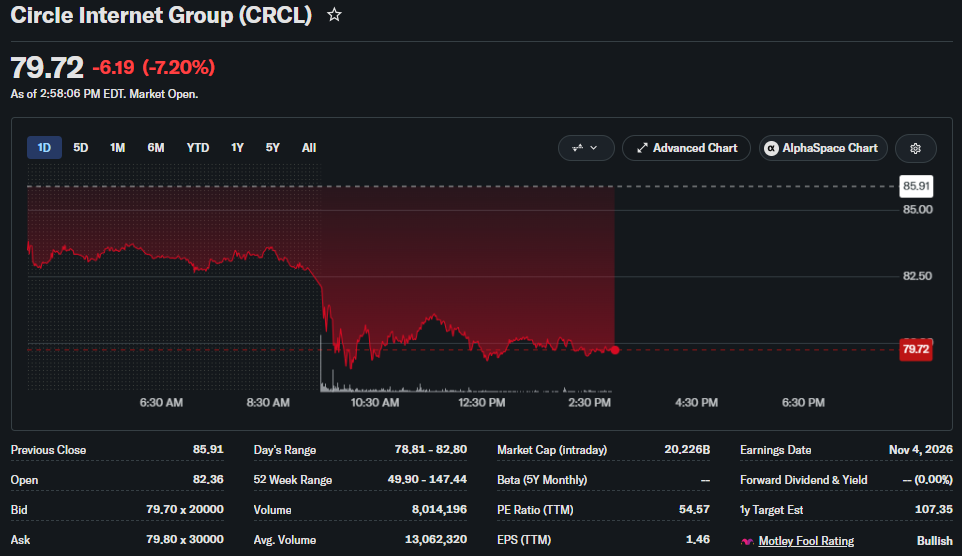
Mizuho cut its price target to $43 from $45 and maintained an Underperform rating, according to a research note cited in a report. The firm said its tests of AI personal assistants found that they tended to recommend higher-yielding, FDIC-insured alternatives to USDC when users asked where to hold cash.
The analysis raises a potential challenge to Circle’s business model, which depends heavily on income generated by the reserves backing USDC. Mizuho estimated that AI-driven changes in user preferences could put 10% to 20% of Circle’s reserve revenue at risk and reduce USDC’s market capitalization by $4 billion to $9 billion over the medium term.
The findings describe a potential risk rather than a measured decline in USDC demand. There is no indication in the report that AI assistants have already caused a material shift in stablecoin holdings.
Mizuho sees competition from AI financial assistants
Mizuho’s analysis focused on how AI assistants respond when users ask where to keep their money. According to the report, the tested agents showed a preference for bank accounts offering deposit insurance and higher yields over USDC. The firm also found that when users specified a preference for remaining within crypto, the assistants tended to favor platforms other than Circle, according to the reported findings.
The concern is that AI agents could increasingly influence how consumers select financial products, including where they hold cash. If those systems consistently recommend insured bank deposits over stablecoins, USDC could face additional competition for balances.
Mizuho’s projected $4 billion to $9 billion reduction in USDC market capitalization and 10% to 20% exposure to reserve revenue are estimates of potential medium-term effects. They are not reported losses or confirmed changes in Circle’s customer balances.
Circle reports $36 trillion in USDC settlement volume
Circle has highlighted the scale of USDC activity and its distribution network in response to questions about the economics of stablecoin issuance. In an October 16 blog post, the company said USDC processed more than $36 trillion in on-chain transaction volume during the first half of 2026. Circle also reported minting and redeeming more than $315 billion of USDC during the period, equivalent to approximately $1.7 billion per day.
The company said it paid $819 million to distribution partners and in transaction costs during the first half. USDC accounted for approximately 77% of global stablecoin transaction volume in June, up from 60% a year earlier, according to Circle.
Circle also disclosed that it generated approximately $1.4 billion in revenue during the first half of 2026. About $819 million went toward partner distribution and transaction costs, while the company spent approximately $473 million on areas including compliance, banking relationships, settlement liquidity, licensing, and product development.
These figures reflect Circle’s own account of its business economics. They show the scale of its existing distribution and infrastructure spending, but do not directly address Mizuho’s concern about whether AI assistants could influence future demand for USDC.
The company has argued that its partner network, redemption infrastructure and regulatory footprint are central to USDC’s use across financial platforms. It also said customers can access standard redemptions through existing payment rails, with additional near-real-time settlement options available through its own payment network and platform.
Crypto market weakness adds to the pressure
Circle’s decline came during a weaker session for major cryptocurrencies. Bitcoin traded at $79,920.90, down 0.8% over 24 hours, while Ethereum fell 1.6% to $2,312.10. Bitcoin’s market capitalization stood at approximately $1.607 trillion, with 24-hour trading volume of $28.62 billion. Ethereum had a market capitalization of about $282.52 billion and trading volume of $10.46 billion, according to CoinGecko data (at 6:58 p.m. UTC on October 26).
According to Yahoo Finance data (at 6:58 p.m. UTC on October 26), Circle had an intraday market capitalization of approximately $20.23 billion, with a reported trailing price-to-earnings ratio of 54.57 and earnings per share of $1.46. The company is scheduled to report its next earnings on November 4, 2026.
The decline in Circle shares coincided with Mizuho’s revised price target and weakness across the broader crypto market. However, the available trading data does not establish that either development directly caused the stock’s decline or quantify their respective influence on the share price.
Also Read: ASST Stock Price Drops 5% as Strive Adds 6,182 Bitcoin to Treasury