

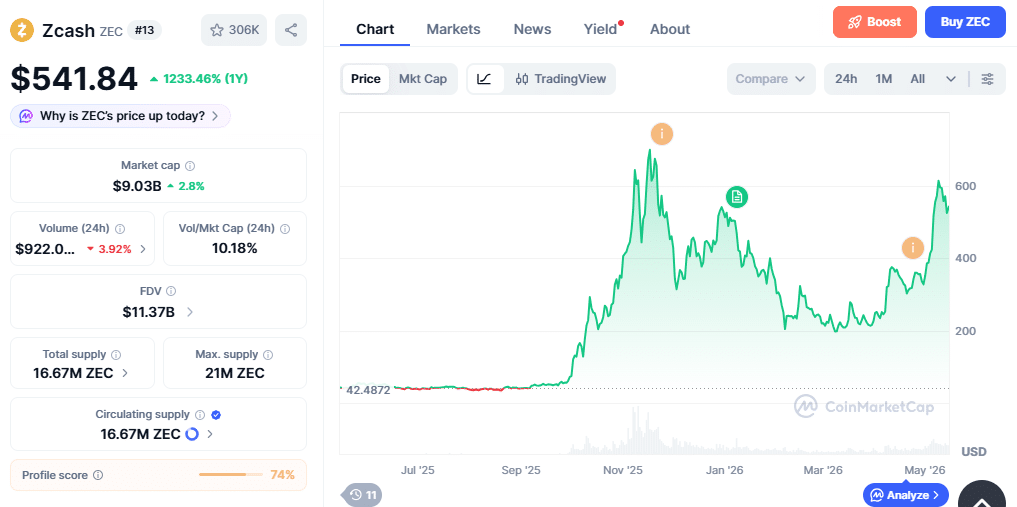
Zcash has delivered the most dramatic re-rating of any major cryptocurrency in the current cycle—surging 1,233% over the past year from approximately $40 to $541.84, pushing its market cap to $9.03 billion.
The move is not a meme coin pump or a leverage-driven squeeze. It is the product of a 12-month sequence of structural catalysts—supply shock, regulatory clearance, institutional accumulation, ecosystem restructuring, and a privacy narrative that has shifted from regulatory liability to institutional asset—converging on a token that was trading below $30 as recently as mid-2024.

Here is the timeline of how Zcash went from written-off privacy relic to one of 2026’s standout performers.
November 2024: The Halving That Changed Everything
The catalyst that set the rally in motion was Zcash’s fourth halving on November 18, 2024, which cut the block reward from 3.125 ZEC to 1.5625 ZEC — reducing daily new issuance from approximately 3,600 to 1,800 coins.
The supply mechanics are stark. With a fixed maximum supply of 21 million ZEC (identical to Bitcoin’s cap) and 16.67 million already in circulation, the halving tightened the issuance curve at precisely the moment when demand catalysts began stacking.
ZEC was trading around $40–50 before the halving. Within three months, it had tripled. By November 2025, it had reached $750 — its all-time high — representing gains exceeding 1,200% from the pre-halving low. A sharp correction followed, pulling the price back approximately 60% to the $230–270 range by early 2026. The current rally to $541 represents the second leg of a recovery that has now erased all 2026 losses.
January 2026: SEC Closes Investigation Without Action
On January 15, 2026, the U.S. Securities and Exchange Commission officially closed its nearly two-year investigation into the Zcash Foundation without recommending any enforcement action. ZEC rallied more than 4% on the day, briefly exceeding $427.
The significance extended far beyond the price move. The SEC investigation had been a persistent overhang that suppressed institutional participation. Its closure removed the single largest regulatory uncertainty facing the token and opened the door for the institutional catalysts that followed.
Late 2025–Early 2026: Grayscale Files for First Privacy-Coin Spot ETF
In late 2025, Grayscale Investments filed to convert its existing Zcash Trust (ticker: ZCSH) into a U.S.-listed spot ETF — the first such filing for any privacy-focused cryptocurrency. An approval would create a regulated institutional onramp to ZEC exposure without requiring direct token custody.
The filing arrived with the SEC investigation freshly resolved and amid a broader ETF expansion cycle that had already seen Bitcoin and Ethereum spot ETFs attract billions in institutional capital. Analysts have projected a potential decision in the second half of 2026. The Grayscale Zcash Trust reported net assets of $200.4 million at the start of Q1 2026, though this declined to $99.4 million during the Q1 correction before the current recovery.
Q1 2026: Ecosystem Restructuring and ZODL’s Emergence
The Electric Coin Company (ECC), the original development organization behind Zcash, underwent a major restructuring in Q1 2026. The Zashi wallet development team spun out to form an independent company, launching the cashZ wallet from the Zashi codebase. The broader ecosystem reorganized into five independent organizations.
From this restructuring emerged ZODL (Zcash Open Development Lab), led by CEO Josh Swihart, which raised $25 million in private investment and assumed leadership of protocol development. ZODL published a strategic roadmap on April 13 covering four quadrants: post-quantum security, security hardening, scalability research, and user experience.
The reorganization was not without controversy—some analysts flagged governance transition risk. But the $25 million raise and the clarity of the development roadmap provided sufficient confidence to institutional backers.
Institutional Accumulation: Multicoin, Cypherpunk, Winklevoss, Silbert
The institutional bid for ZEC has been the most visible feature of the 2026 rally. Multicoin Capital emerged as one of the most prominent accumulators, citing rising political risks and demand for “seizure-resistant assets”—framing Zcash as a privacy-focused hedge against wealth taxes and asset confiscation. The firm’s thesis explicitly connected privacy infrastructure to macro-political trends rather than treating it as a niche crypto category.
Cypherpunk Technologies (Nasdaq: CYPH) acquired over $90 million worth of ZEC, representing one of the largest publicly reported institutional positions. The Winklevoss twins (Gemini founders) and Barry Silbert (Digital Currency Group founder) have both made significant investments. Silbert’s DCG is the parent company of Grayscale, creating an integrated institutional pipeline from trust product to potential spot ETF.
Robinhood’s listing of ZEC and THORChain’s integration further expanded retail and DeFi access, creating new liquidity channels that had been absent during the 2023–2024 delisting cycle.
May 2026: The Wall Street Journal, 30% Shielded Supply, and the Privacy Narrative Shift
This week, the Wall Street Journal published a feature highlighting Zcash as a purer successor to Bitcoin’s original cypherpunk vision—using zk-SNARKs for shielded transactions that hide sender, receiver, and amount details. The piece noted that a record 30% of ZEC supply now sits in shielded privacy pools, a milestone that demonstrates growing adoption of the protocol’s core feature.
The WSJ coverage represents a narrative shift that would have been unthinkable 18 months ago, when privacy coins were widely perceived as regulatory targets headed for extinction. Multiple major exchanges had delisted privacy assets. The EU’s Markets in Crypto-Assets (MiCA) framework threatened further restrictions. Binance placed ZEC on its community voting watchlist.
What changed was not the regulatory environment — the EU’s Anti-Money Laundering Regulation (AMLR), which takes effect in July 2027, will require crypto service providers to cease accepting privacy coins on EU-regulated exchanges. What changed was the market’s assessment of whether privacy infrastructure has value despite regulatory friction.
The answer, as expressed by $9 billion in market cap and 1,233% in price appreciation, is emphatically yes.
The Post-Quantum Edge
Zcash’s post-quantum security roadmap adds a forward-looking dimension that most competitors lack. ZODL CEO Josh Swihart announced in early May that a quantum-recoverable wallet will launch in June 2026 — an interim security measure allowing users to migrate funds to a safe environment if quantum computers suddenly compromise current encryption. The full post-quantum protocol overhaul, replacing zk-SNARKs with quantum-resistant primitives, is targeted for completion by 2027.
This timeline is among the most aggressive of any major blockchain. Zcash’s urgency is well-founded: its privacy model relies entirely on zk-SNARKs using elliptic curves (BLS12-381). A quantum attack could not only steal funds but also potentially reveal private transactions retroactively—a catastrophic failure for a privacy chain.
Project Tachyon, part of the PQ roadmap, proposes Oblivious Synchronisation that would remove ciphertexts from the blockchain entirely. Combined with the quantum-resistant cryptographic transition, this positions Zcash as one of the most technically forward-looking chains in the market — a narrative that complements the privacy thesis rather than competing with it.
The Risk Picture
The rally is not without significant risks. The EU’s AMLR deadline in July 2027 will force privacy coin delistings on European exchanges. If Grayscale’s ETF application is rejected, a major demand catalyst disappears. The governance transition from ECC to ZODL introduces execution risk. ZEC’s annual monetary inflation rate, while reduced by the halving, still requires steady demand to absorb new issuance. And an RSI near 79 signals overbought conditions that historically precede short-term pullbacks.
The 24-hour trading volume of $922 million and a volume-to-market-cap ratio of 10.18% suggest genuine capital commitment rather than thin-liquidity manipulation. But the token has a total supply of only 16.67 million coins with a maximum of 21 million — meaning the market cap is highly sensitive to relatively small capital flows.
What 1,233% in 12 Months Actually Means
Zcash’s rally is the market’s answer to the question that dominated crypto discourse in 2023 and 2024: do privacy coins have a future?
The answer has been delivered by capital, not by commentary. A halving that tightened supply. An SEC investigation that ended without action. A Grayscale ETF filing that created institutional optionality. Multicoin and Cypherpunk accumulating nine figures in ZEC. A Wall Street Journal feature that reframed privacy as a feature rather than a flaw. And a development team that is building toward a post-quantum future while most chains are still debating whether to start.
Also Read: Hyperliquid Surges 21% as HYPE ETF Debuts on Nasdaq and Coinbase Deepens Ties